
Safety Warning
DIY auto repair can cause serious injury, fire, or vehicle damage. These guides are for informational purposes only. Always follow OEM torque specs, wear PPE, and consult a certified mechanic if you are unsure. You are solely responsible for your safety.
2012 Ford Edge AWD V6-3.5LFACTORY OEM SERVICE PROCEDURE
Information Bus: Description and Operation
Communications Network
Multiplexing is a method of sending 2 or more signals simultaneously over a single circuit. Multiplexing allows 2 or more electronic modules (nodes) to communicate simultaneously over a twisted wire pair [data (+) and data (-)] network. The information or messages that can be communicated on these wires consists of commands, status or data. The advantage of using multiplexing is to reduce the weight of the vehicle by reducing the number of redundant components and electrical wiring.
The vehicle has 2 module communication networks connected to the Data Link Connector (DLC) and communicate with the scan tool. The communication networks are:
- High Speed Controller Area Network (HS-CAN)
- Medium Speed Controller Area Network (MS-CAN)
The Infotainment Controller Area Network (I-CAN) is connected to the DLC (Data Link Connector), but the I-CAN (Infotainment Controller Area Network) modules communicate with the scan tool over the HS-CAN (High Speed Controller Area Network). The Instrument Panel Cluster (IPC) is used as a gateway module for the messages to transfer between the scan tool and the modules on the I-CAN (Infotainment Controller Area Network).
Network Topology
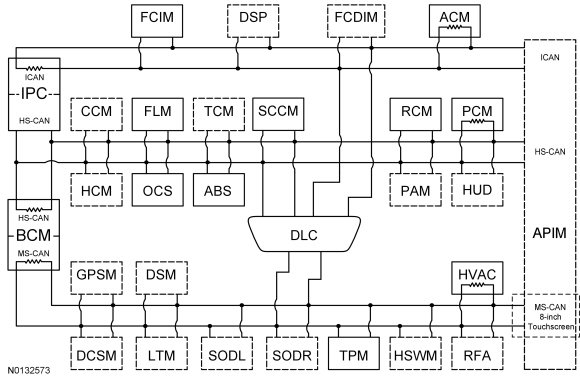
NOTE: Dashed lines indicate an optional module.
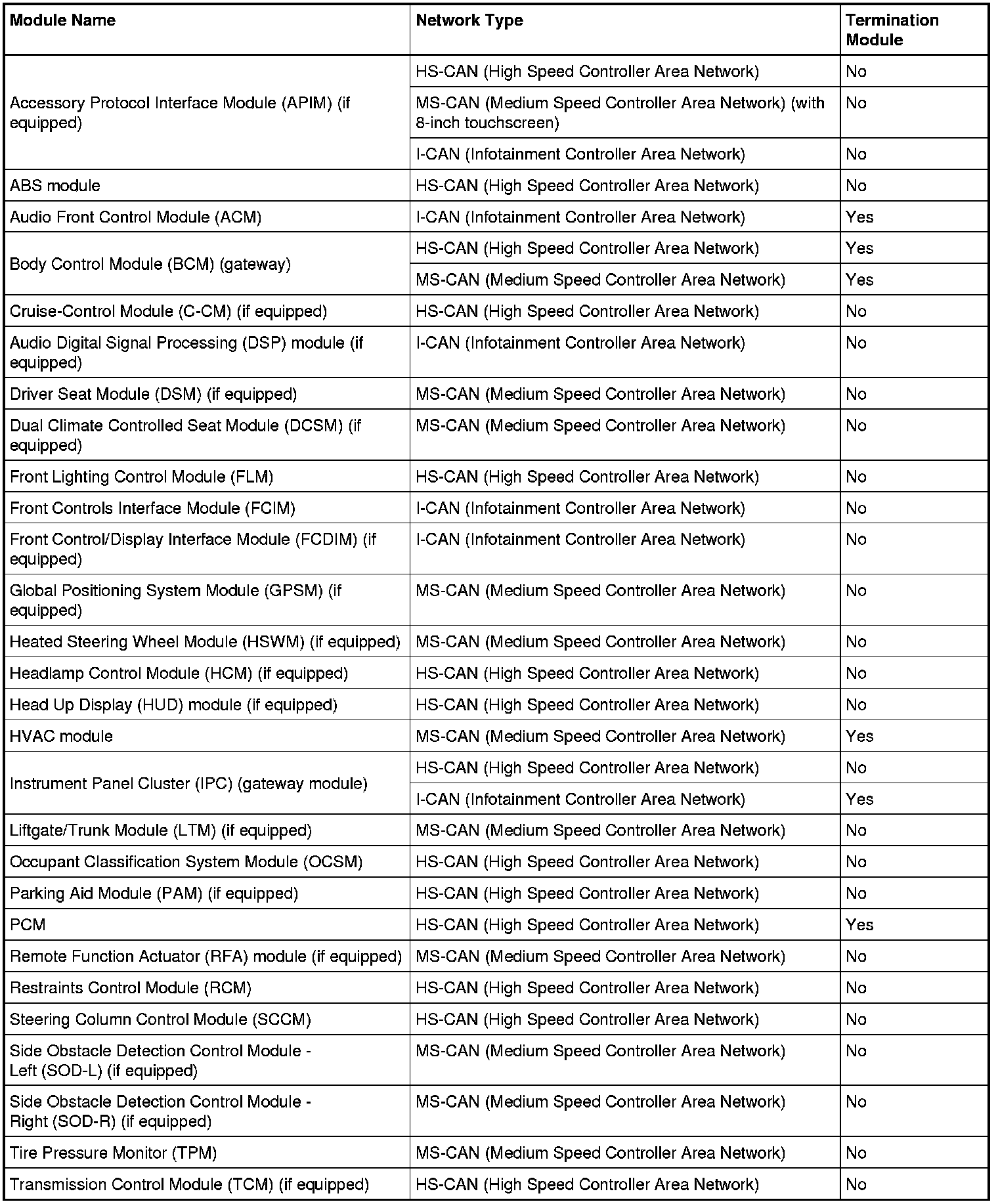
Network Termination
The Controller Area Network (CAN) uses network termination to improve communication reliability. Termination modules are located at both ends of the network. As network messages are broadcast in the form of voltage signals, the network voltage signals are stabilized by the termination resistors.
Each termination module has an internal 120 ohm resistor that bridges across the positive and negative bus connection. With two 120 ohm resistors located in a parallel circuit configuration, the total network impedance, or total resistance, is 60 ohms.
Network termination improves bus message reliability by:
- stabilizing bus voltage.
- eliminating electrical interference.
Gateway Modules
The Instrument Panel Cluster (IPC) and Body Control Module (BCM) are gateway modules. The IPC (Instrument Panel Cluster) translates messages on the HS-CAN (High Speed Controller Area Network) to the I-CAN (Infotainment Controller Area Network) and vice versa. The BCM (Body Control Module) translates messages on the HS-CAN (High Speed Controller Area Network) to the MS-CAN (Medium Speed Controller Area Network) and vice versa. This allows a message to be distributed throughout all three networks.
The IPC (Instrument Panel Cluster) and the BCM (Body Control Module) are the only modules on this vehicle that have this ability.
Factory Service Tools
Use the Manual With the Right Hardware
Pair factory procedures with proven DIY tools so the instructions are easier to execute.
Disclosure: Verified tool recommendations may earn an affiliate commission at no cost to you.
When to See a Mechanic
Stop DIY work and contact a certified mechanic immediately if any of the following apply:
- • You smell fuel, burning insulation, or see smoke.
- • Brakes feel soft, pull hard to one side, or make grinding noises.
- • The engine overheats, stalls repeatedly, or misfires under load.
- • You are missing required tools, torque specs, or safe lifting equipment.
- • You are not confident in the next step or safety outcome.