
Safety Warning
DIY auto repair can cause serious injury, fire, or vehicle damage. These guides are for informational purposes only. Always follow OEM torque specs, wear PPE, and consult a certified mechanic if you are unsure. You are solely responsible for your safety.
2011 Ford Explorer AWD V6-3.5LFACTORY OEM SERVICE PROCEDURE
Cruise Control: Adjustments
Cruise Control Module (C-CM) (with Sensor) Adjustment
General Procedure
NOTE: In order to align the C-CM (Cruise-Control Module), the vehicle must be in a wheel alignment bay station so that the vehicle is level.
NOTE: Damage to the C-CM (Cruise-Control Module) bracket may affect correct alignment. When aligning the C-CM (Cruise-Control Module), inspect the C-CM (Cruise-Control Module) bracket for damage and repair as necessary before carrying out the alignment procedure.
1. Remove the front bumper cover. REFER to Bumper - Exploded View, Front Bumper - Exploded View, Front.
2. Place the vehicle on a wheel alignment bay station.
3. Locate the C-CM (Cruise-Control Module) radar sensor alignment screw.
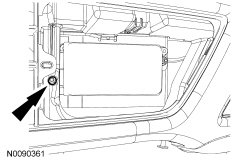
4. Place a combination square level on the face of the C-CM (Cruise-Control Module) radar sensor unit and check vertical alignment.
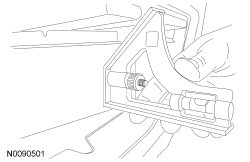
5. Keeping the combination square level on the face of the C-CM (Cruise-Control Module) radar sensor unit, adjust the pitch of the sensor by using an E5 inverted Torx(R) bit to adjust the screw until the sensor is vertical and level.
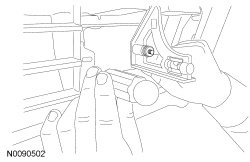
6. NOTE: Prior to installing the front bumper cover, clean and remove any debris on the front or back of the cover.
Install the front bumper cover. REFER to Bumper - Exploded View, Front Bumper - Exploded View, Front.
7. NOTE: The engine must be running during the scan tool horizontal calibration procedure. Failure to leave the engine running throughout the entire procedure results in the cancellation of the alignment procedure and the system remains non-functional.
Start the engine.
8. Follow the operating instructions shown on the IDS (Integrated Diagnostic System) and carry-out the C-CM (Cruise-Control Module) calibration procedure.
9. Follow the prompts to drive the vehicle after successful completion of the procedure. This may take several minutes.
Factory Service Tools
Use the Manual With the Right Hardware
Pair factory procedures with proven DIY tools so the instructions are easier to execute.
Disclosure: Verified tool recommendations may earn an affiliate commission at no cost to you.
When to See a Mechanic
Stop DIY work and contact a certified mechanic immediately if any of the following apply:
- • You smell fuel, burning insulation, or see smoke.
- • Brakes feel soft, pull hard to one side, or make grinding noises.
- • The engine overheats, stalls repeatedly, or misfires under load.
- • You are missing required tools, torque specs, or safe lifting equipment.
- • You are not confident in the next step or safety outcome.