
Safety Warning
DIY auto repair can cause serious injury, fire, or vehicle damage. These guides are for informational purposes only. Always follow OEM torque specs, wear PPE, and consult a certified mechanic if you are unsure. You are solely responsible for your safety.
2011 Ford Expedition 2WD V8-5.4LFACTORY OEM SERVICE PROCEDURE
Throttle Position Sensor: Service and Repair
Throttle Position (TP) Sensor
Removal
1. Remove the Throttle Body (TB). For additional information, refer to Fuel Charging and Controls - 5.4L (3V) Service and Repair.
2. NOTICE: Do not put direct heat on the Throttle Position (TP) sensor or any other plastic parts because heat damage may occur. Damage may also occur if Electronic Throttle Body (ETB) temperature exceeds 120°C (248°F).
NOTE: Do not use power tools.
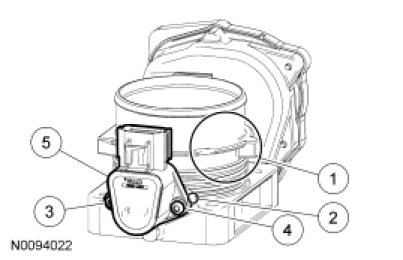
Remove the Throttle Position (TP) sensor.
1. Using a heat gun, apply heat to the top of the Electronic Throttle Body (ETB) until the top TP sensor bolt ear reaches approximately 55°C (130°F), this should take no more than 3 minutes using an 1,100-watt heat gun. The heat gun should be about 25.4 mm (1 in) away from the ETB.
2. Monitor the temperature of the top TP sensor bolt ear on the ETB with a digital temperature laser or infrared thermometer, while heating the ETB.
3. Using hand tools, quickly remove the bolt farthest from the heat source first and discard.
4. Using hand tools, remove the remaining bolt and discard.
5. Remove and discard the TP sensor.
Installation
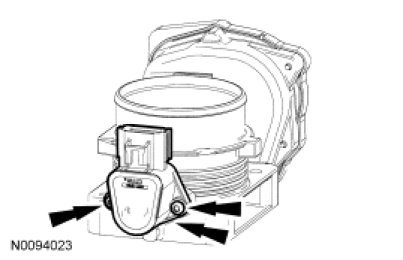
1. NOTE: When installing the new TP sensor, make sure that the radial locator tab on the TP sensor is aligned with the radial locator hole on the ETB.
NOTE: Do not use power tools.
Install the new TP sensor.
- Using hand tools, install the 2 new bolts.
- Tighten to 3 Nm (27 lb-in).
2. Install the TB. For additional information, refer to Fuel Charging and Controls - 5.4L (3V) Service and Repair.
Factory Service Tools
Use the Manual With the Right Hardware
Pair factory procedures with proven DIY tools so the instructions are easier to execute.
Disclosure: Verified tool recommendations may earn an affiliate commission at no cost to you.
When to See a Mechanic
Stop DIY work and contact a certified mechanic immediately if any of the following apply:
- • You smell fuel, burning insulation, or see smoke.
- • Brakes feel soft, pull hard to one side, or make grinding noises.
- • The engine overheats, stalls repeatedly, or misfires under load.
- • You are missing required tools, torque specs, or safe lifting equipment.
- • You are not confident in the next step or safety outcome.