
Safety Warning
DIY auto repair can cause serious injury, fire, or vehicle damage. These guides are for informational purposes only. Always follow OEM torque specs, wear PPE, and consult a certified mechanic if you are unsure. You are solely responsible for your safety.
2011 Ford Edge FWD V6-3.7LFACTORY OEM SERVICE PROCEDURE
Alignment: Description and Operation
Wheel Alignment Angles
NOTE: When making rear alignment adjustments, it is important to know that when adjustments are made to the rear toe, the rear camber will also be adjusted (in the same direction as the toe adjustment). When making adjustments to the rear camber, the rear toe will also be adjusted (in the opposite direction of the camber adjustment). It will be necessary to check the rear camber whenever rear toe adjustments are made and to check the rear toe whenever rear camber adjustments are made.
Front toe is adjusted through the use of adjustable tie-rod ends. Front camber is adjusted through the use of the upper strut plate. Rotating the upper strut plate 180 degrees will change the camber +0.4 degrees. Front caster is not adjustable on the vehicle. Rear toe is adjusted through the use of adjustable toe link cams. Rear camber is adjusted through the use of a cam bolt that attaches the rear lower control arm to the rear subframe.
Camber
Negative and Positive Camber
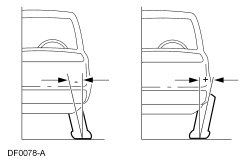
Camber is the vertical tilt of the wheel when viewed from the front. Camber can be positive or negative and has a direct affect on tire wear.
Caster
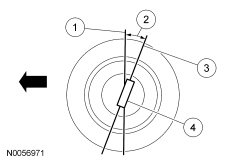

Caster is the deviation from vertical of an imaginary line drawn through the ball joints when viewed from the side. The caster specifications will give the vehicle the best directional stability characteristics when loaded and driven. The caster setting is not related to tire wear.
Toe
Positive Toe (Toe In)
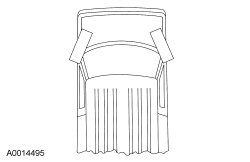
Negative Toe (Toe Out)
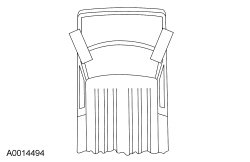
The vehicle toe setting affects tire wear and directional stability.
Incorrect Thrust Angle (Dogtracking)
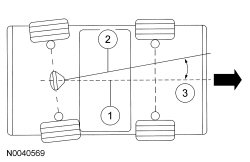

Incorrect thrust angle (also known as dogtracking) is the condition in which the rear axle is not square to the chassis. Heavily crowned roads can give the illusion of dogtracking.
Wander
Wander is the tendency of the vehicle to require frequent, random left and right steering wheel corrections to maintain a straight path down a level road.
Shimmy
Shimmy, as observed by the driver, is large, consistent, rotational oscillations of the steering wheel resulting from large, side-to-side (lateral) tire/wheel movements.
Shimmy is usually experienced near 64 km/h (40 mph), and can begin or be amplified when the tire contacts pot holes or irregularities in the road surface.
Nibble
Sometimes confused with shimmy, nibble is a condition resulting from tire interaction with various road surfaces and observed by the driver as small rotational oscillations of the steering wheel. For wheel and tire diagnosis, refer to Wheels and Tires.
Poor Returnability/Sticky Steering
Poor returnability and sticky steering is used to describe poor return of the steering wheel to center after a turn or steering correction.
Drift/Pull
Pull is a tugging sensation, felt by the hands on the steering wheel, that must be overcome to keep the vehicle going straight.
Drift describes what a vehicle with this condition does with hands off the steering wheel.
- A vehicle-related drift/pull, on a flat road, will cause a consistent deviation from the straight-ahead path and require constant steering input in the opposite direction to counteract the effect.
- Drift/pull may be induced by conditions external to the vehicle (for example, wind, road crown).
Poor Groove Feel
Poor groove feel is characterized by little or no buildup of turning effort felt in the steering wheel as the wheel is rocked slowly left and right within very small turns around center or straight-ahead (under 20 degrees of steering wheel turn). Efforts may be said to be "flat on center."
- Under 20 degrees of turn, most of the turning effort that builds up comes from the mesh of gear teeth in the steering gear. In this range, the steering wheel is not yet turned enough to feel the effort from the self-aligning forces at the road wheel or tire patch.
- In the diagnosis of a roadability problem, it is important to understand the difference between wander and poor groove feel.
Factory Service Tools
Use the Manual With the Right Hardware
Pair factory procedures with proven DIY tools so the instructions are easier to execute.
Disclosure: Verified tool recommendations may earn an affiliate commission at no cost to you.
When to See a Mechanic
Stop DIY work and contact a certified mechanic immediately if any of the following apply:
- • You smell fuel, burning insulation, or see smoke.
- • Brakes feel soft, pull hard to one side, or make grinding noises.
- • The engine overheats, stalls repeatedly, or misfires under load.
- • You are missing required tools, torque specs, or safe lifting equipment.
- • You are not confident in the next step or safety outcome.
Rather have a pro handle this?
A certified mobile mechanic comes to your home or office. They bring the tools, you stay comfortable. No tow truck, no waiting room, no surprises.
Comes to youSame-day available12-month warranty
Get a Free QuoteNo obligation. See pricing before you book.