
Safety Warning
DIY auto repair can cause serious injury, fire, or vehicle damage. These guides are for informational purposes only. Always follow OEM torque specs, wear PPE, and consult a certified mechanic if you are unsure. You are solely responsible for your safety.
2008 Ford Taurus AWD V6-3.5LFACTORY OEM SERVICE PROCEDURE
Test F: The Occupant Classification Sensor (OCS) Module Does Not Communicate With The Scan Tool
PINPOINT TEST F: THE OCCUPANT CLASSIFICATION SENSOR (OCS) MODULE DOES NOT COMMUNICATE WITH THE SCAN TOOL
Normal Operation
The occupant classification sensor (OCS) module communicates with the scan tool through the medium speed controller area network (MS-CAN). Circuits VDB06 (GY/OG) (MS-CAN +) and VDB07 (VT/OG) (MS-CAN -) provide the network connection to the OCS module. The OCS module shares the MS-CAN network with the smart junction box (SJB), the driver seat module (DSM), the electronic automatic temperature control (EATC) module, the digital versatile disc (DVD) player, the satellite radio receiver, and the instrument cluster. Voltage for the OCS module is provided by circuit CBP46 (WH/BU). Circuit GD133 (BK) provides ground.
This pinpoint test is intended to diagnose the following:
- Fuse
- Wiring, terminals or connectors
- OCS module
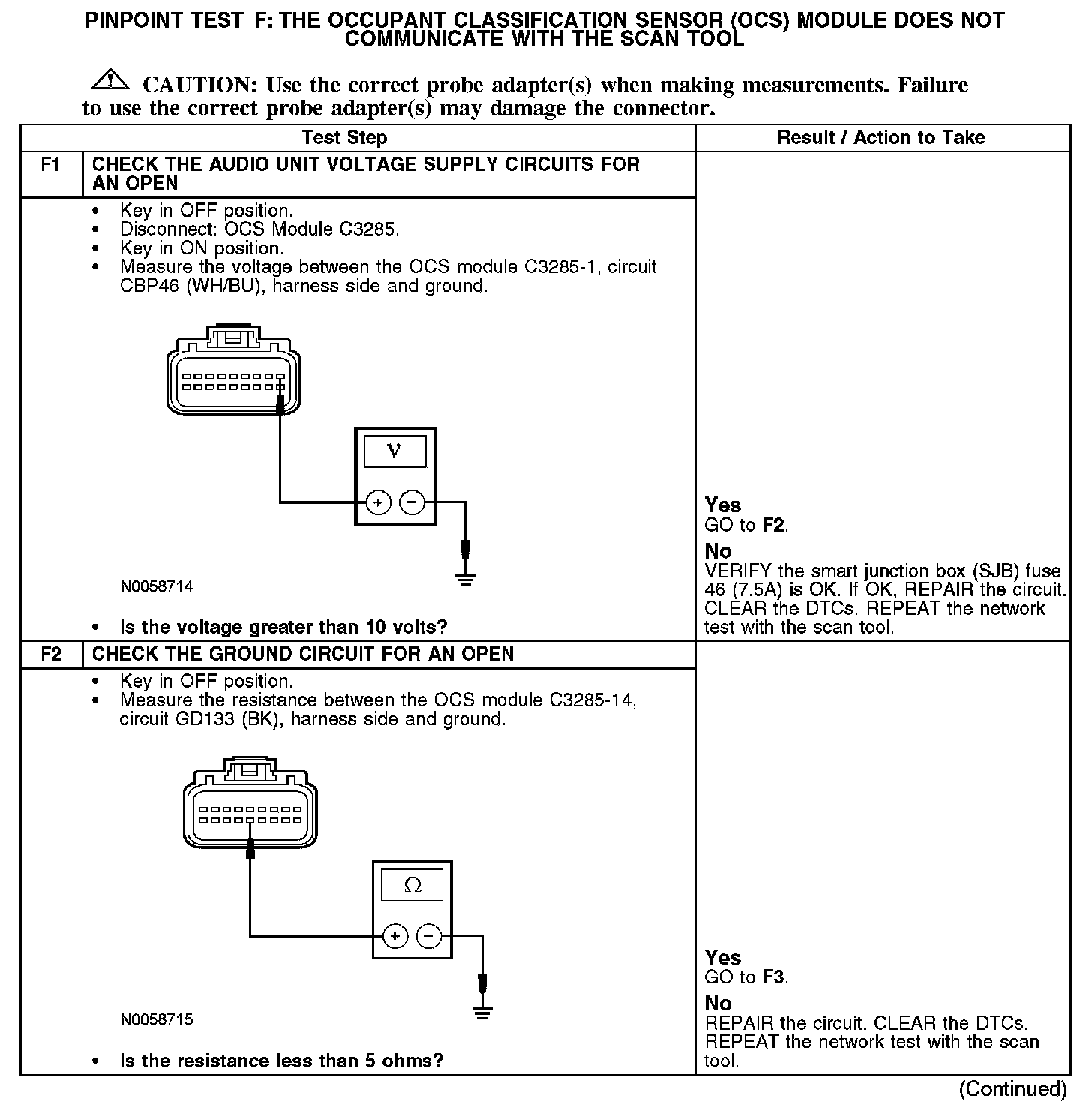
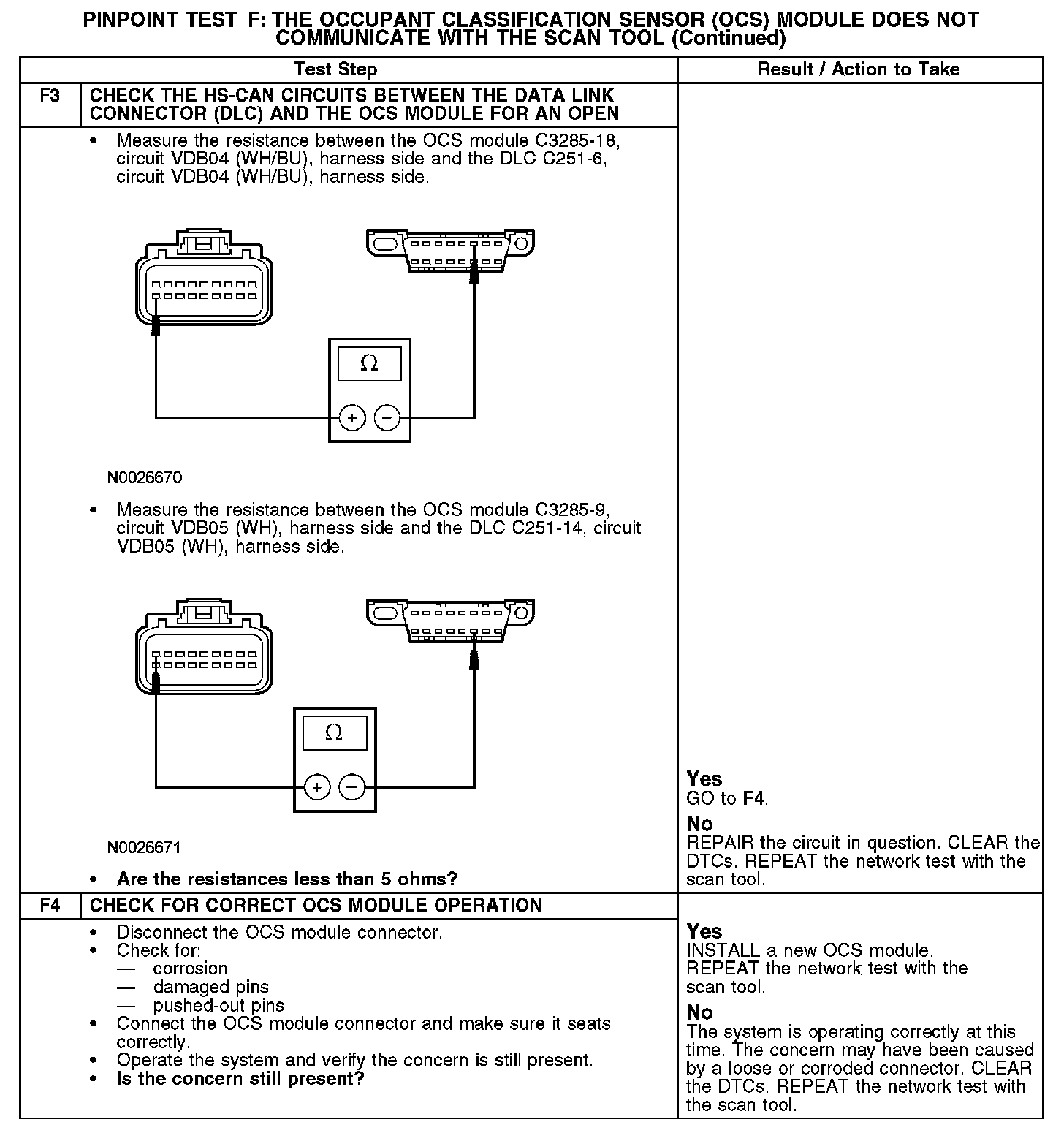
Normal Operation
The occupant classification sensor (OCS) module communicates with the scan tool through the medium speed controller area network (MS-CAN). Circuits VDB06 (GY/OG) (MS-CAN +) and VDB07 (VT/OG) (MS-CAN -) provide the network connection to the OCS module. The OCS module shares the MS-CAN network with the smart junction box (SJB), the driver seat module (DSM), the electronic automatic temperature control (EATC) module, the digital versatile disc (DVD) player, the satellite radio receiver, and the instrument cluster. Voltage for the OCS module is provided by circuit CBP46 (WH/BU). Circuit GD133 (BK) provides ground.
This pinpoint test is intended to diagnose the following:
- Fuse
- Wiring, terminals or connectors
- OCS module
F1-F2:
F3-F4:
Factory Service Tools
Use the Manual With the Right Hardware
Pair factory procedures with proven DIY tools so the instructions are easier to execute.
Disclosure: Verified tool recommendations may earn an affiliate commission at no cost to you.
When to See a Mechanic
Stop DIY work and contact a certified mechanic immediately if any of the following apply:
- • You smell fuel, burning insulation, or see smoke.
- • Brakes feel soft, pull hard to one side, or make grinding noises.
- • The engine overheats, stalls repeatedly, or misfires under load.
- • You are missing required tools, torque specs, or safe lifting equipment.
- • You are not confident in the next step or safety outcome.