
Safety Warning
DIY auto repair can cause serious injury, fire, or vehicle damage. These guides are for informational purposes only. Always follow OEM torque specs, wear PPE, and consult a certified mechanic if you are unsure. You are solely responsible for your safety.
2008 Ford Expedition 2WD V8-5.4LFACTORY OEM SERVICE PROCEDURE
Seat Temperature Control Module: Service and Repair
DUAL CLIMATE CONTROLLED SEAT MODULE (DCSM)
Removal and Installation
WARNING: Never probe the electrical connectors on safety belt buckle/retractor pretensioners or adaptive load limiting retractors. Failure to follow this instruction may result in the accidental deployment of the safety belt pretensioners or adaptive load limiting retractors, which increases the risk of serious personal injury or death.
NOTE:
- The air bag warning indicator illuminates when the restraints control module (RCM) fuse is removed and the ignition switch is ON. This is normal operation and does not indicate a supplemental restraint system (SRS) fault.
- The SRS must be fully operational and free of faults before releasing the vehicle to the customer.
1. When installing a new dual climate controlled seat module (DCSM), carry out the appropriate steps in the programmable module installation (PMI) procedure.
2. Position the front passenger seat fully upward and depower the SRS.
3. CAUTION: Do not pull from the inboard side of the front seat cushion panel shield to avoid damaging it.
Remove the front seat cushion panel shield.
- Release the upper retaining clips working from the outboard side and then release the lower retaining clips.
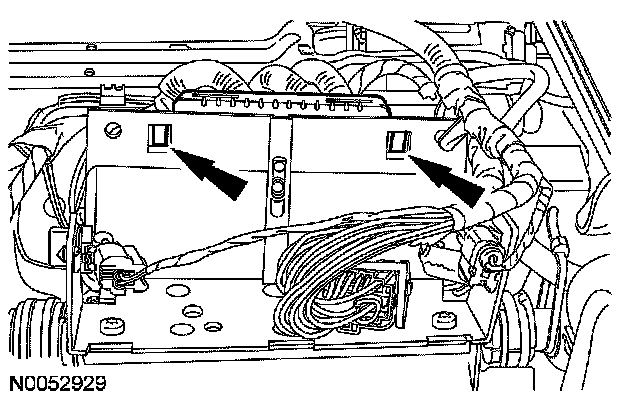
4. Release the 2 tabs and slide out the DCSM.
5. Remove the DCSM.
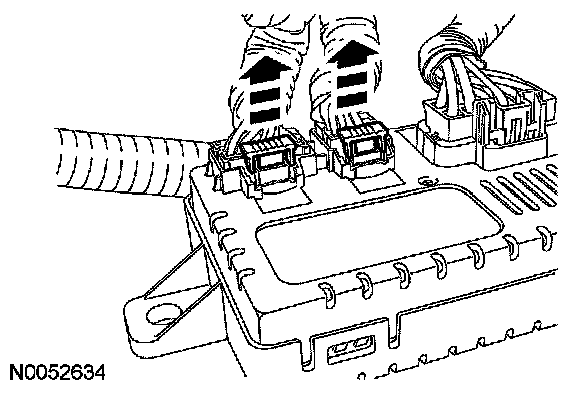
- Cut and remove the wiring harness tie strap.
- Release the 2 locking wedges.
- Disconnect the 3 electrical connectors.
6. To install, reverse the removal procedure.
7. Repower the SRS.
8. If a new DCSM has been installed, carry out the appropriate steps in the PMI procedure.
Removal and Installation
WARNING: Never probe the electrical connectors on safety belt buckle/retractor pretensioners or adaptive load limiting retractors. Failure to follow this instruction may result in the accidental deployment of the safety belt pretensioners or adaptive load limiting retractors, which increases the risk of serious personal injury or death.
NOTE:
- The air bag warning indicator illuminates when the restraints control module (RCM) fuse is removed and the ignition switch is ON. This is normal operation and does not indicate a supplemental restraint system (SRS) fault.
- The SRS must be fully operational and free of faults before releasing the vehicle to the customer.
1. When installing a new dual climate controlled seat module (DCSM), carry out the appropriate steps in the programmable module installation (PMI) procedure.
2. Position the front passenger seat fully upward and depower the SRS.
3. CAUTION: Do not pull from the inboard side of the front seat cushion panel shield to avoid damaging it.
Remove the front seat cushion panel shield.
- Release the upper retaining clips working from the outboard side and then release the lower retaining clips.
4. Release the 2 tabs and slide out the DCSM.
5. Remove the DCSM.
- Cut and remove the wiring harness tie strap.
- Release the 2 locking wedges.
- Disconnect the 3 electrical connectors.
6. To install, reverse the removal procedure.
7. Repower the SRS.
8. If a new DCSM has been installed, carry out the appropriate steps in the PMI procedure.
Factory Service Tools
Use the Manual With the Right Hardware
Pair factory procedures with proven DIY tools so the instructions are easier to execute.
Disclosure: Verified tool recommendations may earn an affiliate commission at no cost to you.
When to See a Mechanic
Stop DIY work and contact a certified mechanic immediately if any of the following apply:
- • You smell fuel, burning insulation, or see smoke.
- • Brakes feel soft, pull hard to one side, or make grinding noises.
- • The engine overheats, stalls repeatedly, or misfires under load.
- • You are missing required tools, torque specs, or safe lifting equipment.
- • You are not confident in the next step or safety outcome.