
Safety Warning
DIY auto repair can cause serious injury, fire, or vehicle damage. These guides are for informational purposes only. Always follow OEM torque specs, wear PPE, and consult a certified mechanic if you are unsure. You are solely responsible for your safety.
2007 Ford Edge FWD V6-3.5LFACTORY OEM SERVICE PROCEDURE
Body and Frame: Service Precautions
Welding Precautions - Steel
General Specifications
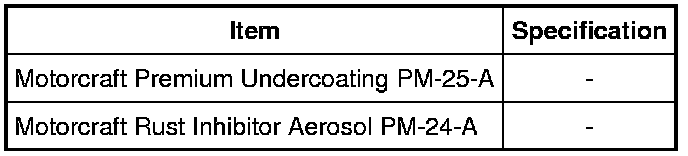
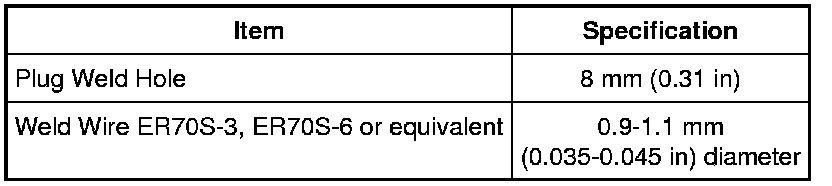
General Specifications -Welding Specifications
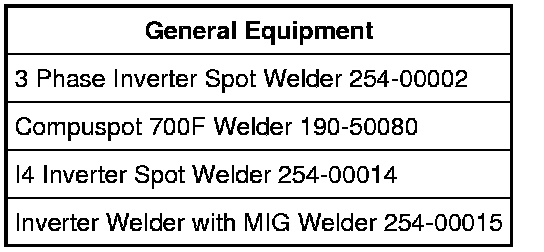
WARNING: Invisible ultraviolet and infrared rays emitted in welding can injure unprotected eyes and skin. Always use protection such as a welder's helmet with dark-colored filter lenses of the correct density. Electric welding will produce intense radiation, therefore, filter plate lenses of the deepest shade providing adequate visibility are recommended. It is strongly recommended that persons working in the weld area wear flash safety goggles. Also wear protective clothing. Failure to follow these instructions may result in serious personal injury.
WARNING: Always wear protective equipment including eye protection with side shields, and a dust mask when sanding or grinding. Failure to follow these instructions may result in serious personal injury.
WARNING: On vehicles equipped with Safety Canopy(R) options, prior to carrying out any sectioning repairs near the roof line or sail panel areas of the vehicle, remove the Safety Canopy(R) module and related components. Failure to comply may result in accidental deployment or damage to the Safety Canopy(R). Failure to follow these instructions may result in serious injury to technician or vehicle occupant(s).
NOTICE: Electronic modules and related wiring can be damaged when exposed to heat from welding procedures. Carefully disconnect and remove, or position away from heat affected areas.
NOTE: When it is necessary to carry out weld-bonding procedures, refer to Weld-Bonding .
- A test weld should always be carried out on a test sample. Refer to the weld nugget chart in Specifications for Ford-approved weld nugget information.
- The correct protective clothing should always be worn.
- Adequate ventilation must be provided to avoid accumulation of poisonous gases.
- Place protective covers around components and wiring harnesses to protect from welding spatter.
- Follow equipment manufacturer's prescribed procedures and equipment settings for the type of weld being used.
- Use grinding discs and wire brushes dedicated to the type of material being welded.
- Follow equipment manufacturer's prescribed procedures and equipment settings for the type of weld being used. ER70S-3 or ER70S-6 wire are typically used for Metal Inert Gas (MIG) welding steel.
- Disconnect the battery ground cable from the battery.
- Components made of High-Strength Steel (HSS) should not be heated to straighten or repair. Severely bent or kinked components should be replaced with new ones.
- Factory spot welds may be substituted with either Squeeze-Type Resistance Spot Welding (STRW) welds or MIG plug welds. Spot/plug welds should equal factory welds in both location and quantity. Do not place a new spot weld directly over an original weld location. Plug weld hole should equal 8 mm (0.31 in) diameter.
- Disconnect on-vehicle modules and protect them from possible heat damage and electrical currents when welding.
- Use of a weld-through primer is recommended where applicable.
- Corrosion protection needs to be restored whenever it is necessary to sand or grind through painted surfaces or E-coat, or when bare metal repairs are carried out. Refer to Restoring Corrosion Protection Following Repair .
Welding Precautions - Dual Phase Steel
The correct equipment and settings must be used when welding dual phase steel. MIG and STRW are the recommended methods. Surfaces must be clean and free of foreign materials.
ER70-S-6 is the recommended wire specification to use when welding dual phase steel components.
Recommended gas mixtures are as follows: Carbon Dioxide (CO2), 92Ar8CO2, 84Ar16CO2 and 77Ar23CO2.
Components made of dual phase steel should not be heated to straighten or repair. Severely bent or kinked components should be replaced with new ones.
Do not use Oxyacetylene equipment to weld dual phase steel.
- The correct protective clothing should always be worn.
- Adequate ventilation must be provided to avoid the accumulation of poisonous gases.
- Place protective covers around components and wiring harnesses to protect from welding spatter.
- Use grinding discs and wire brushes dedicated to the type of material being welded.
- A test weld should always be carried out on a test sample.
- Follow equipment manufacturer's prescribed procedures and equipment settings for the type of weld being used.
- Disconnect the battery ground cable from the battery.
- Disconnect on-vehicle modules and protect them from possible heat damage and electrical currents when welding.
- Factory spot welds may be substituted with either STRW welds or MIG plug welds. Spot/plug welds should equal factory welds in both location and quantity. Do not place a new spot weld directly over an original weld location. Plug weld hole should equal 8 mm (0.31 in) diameter.
- Use of a weld-through primer is recommended where applicable.
- Corrosion protection needs to be restored whenever it is necessary to sand or grind through painted surfaces or E-coat, or when bare metal repairs are carried out. Refer to Restoring Corrosion Protection Following Repair .
Factory Service Tools
Use the Manual With the Right Hardware
Pair factory procedures with proven DIY tools so the instructions are easier to execute.
Disclosure: Verified tool recommendations may earn an affiliate commission at no cost to you.
When to See a Mechanic
Stop DIY work and contact a certified mechanic immediately if any of the following apply:
- • You smell fuel, burning insulation, or see smoke.
- • Brakes feel soft, pull hard to one side, or make grinding noises.
- • The engine overheats, stalls repeatedly, or misfires under load.
- • You are missing required tools, torque specs, or safe lifting equipment.
- • You are not confident in the next step or safety outcome.