
Safety Warning
DIY auto repair can cause serious injury, fire, or vehicle damage. These guides are for informational purposes only. Always follow OEM torque specs, wear PPE, and consult a certified mechanic if you are unsure. You are solely responsible for your safety.
1990 Ford Taurus L4-153 2.5L HSCFACTORY OEM SERVICE PROCEDURE
Compressor
NOTE: Whenever a compressor is replaced, it will be necessary to replace the suction accumulator/drier.
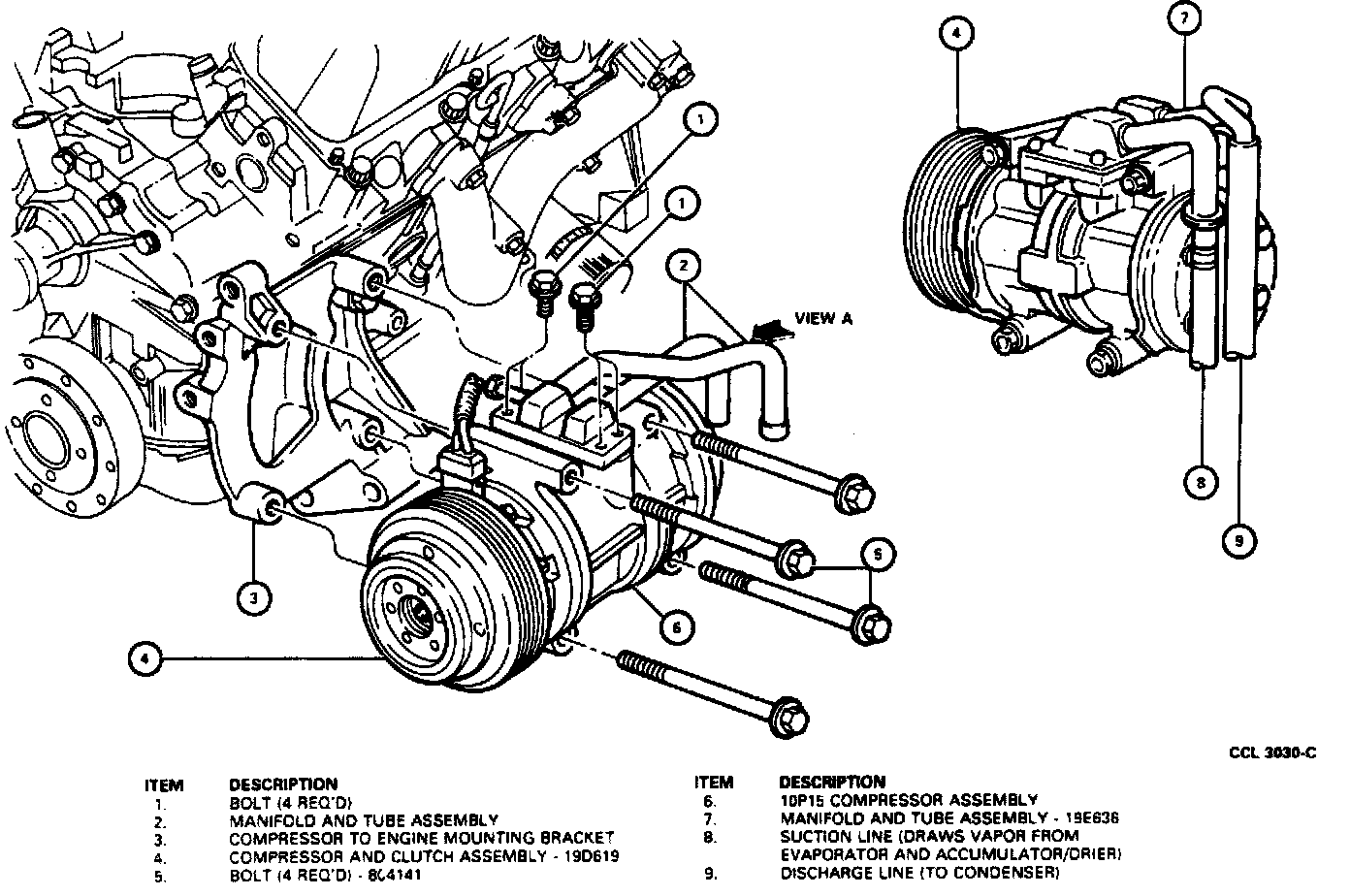
Removal
1. Discharge system following recommended service procedures. Observe all safety precautions.
2. Disconnect compressor clutch wires at field coil connector on compressor.
3. Loosen drive belt.
4. Disconnect hose assemblies from condenser and suction line.
5. Remove four bolts.
6. Remove compressor and manifold and tube assembly from vehicle as a unit. Assembly will not clear sub-frame and radio support if attempt is made to remove unit from bottom. It must be removed from top.
7. Remove manifold and tube assembly as an onbench operation.
8. If compressor is to be replaced, remove clutch and field coil assembly.
Installation
1. New service replacement FS-6 compressor contains 300ml (10 fluid ounces) of specified refrigerant oil. Before replacement compressor installation drain 120ml (4 fluid ounces) of refrigerant oil from compressor. This will maintain total system oil charge within specified limits.
2. Install manifold and tube assembly on A/C compressor (two bolts).
3. Install compressor and manifold and tube assembly on A/C mounting bracket (four bolts).
4. Using new o-rings lubricated with clean refrigerant oil, connect suction line to compressor manifold and tube assembly. Attach discharge line to A/C condenser.
5. Connect clutch wires to field coil connector.
6. Install drive belt. Adjust drive belt tension to 190-217 Nm (140-160 lb-ft).
7. Leak test, evacuate and charge system following recommended service procedures. Observe all safety precautions.
8. Check system for proper operation.
Factory Service Tools
Use the Manual With the Right Hardware
Pair factory procedures with proven DIY tools so the instructions are easier to execute.
Disclosure: Verified tool recommendations may earn an affiliate commission at no cost to you.
When to See a Mechanic
Stop DIY work and contact a certified mechanic immediately if any of the following apply:
- • You smell fuel, burning insulation, or see smoke.
- • Brakes feel soft, pull hard to one side, or make grinding noises.
- • The engine overheats, stalls repeatedly, or misfires under load.
- • You are missing required tools, torque specs, or safe lifting equipment.
- • You are not confident in the next step or safety outcome.