
Safety Warning
DIY auto repair can cause serious injury, fire, or vehicle damage. These guides are for informational purposes only. Always follow OEM torque specs, wear PPE, and consult a certified mechanic if you are unsure. You are solely responsible for your safety.
1990 Ford Probe V6-182 3.0LFACTORY OEM SERVICE PROCEDURE
Ignition Switch: Service and Repair
Fig. 4 Ignition Switch Replacement:
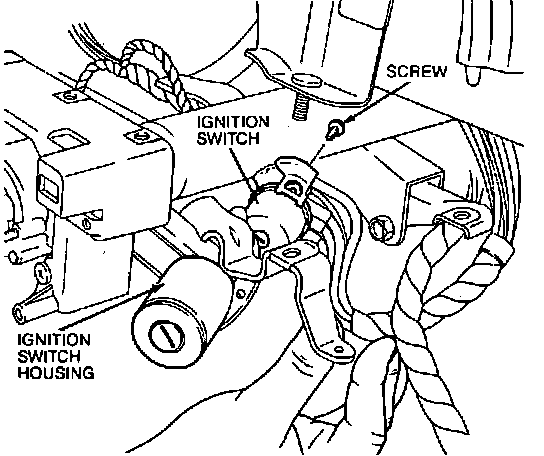
1. Disconnect battery ground cable.
2. Remove steering column upper mounting bolts, then the steering column pivot lock assembly. Allow steering column to hang down. It may be necessary to remove the instrument panel lower panel, lap duct, then defroster duct for access.
3. Remove ignition switch to ignition switch housing attaching screw, Fig. 4.
4. Disconnect four ignition switch snap connectors from left of steering column. Note location of each wire in the four wire connector. The two key-in warning buzzer wires (green and the red/orange tracer) may be removed by disengaging tang with a paper clip or other tool.
5. Remove protective looming from ignition switch wiring.
6. Remove ignition switch from vehicle.
7. Install the two key-in warning buzzer wires by aligning the flat side of the wire end with grooved portion of connector, then pushing wire into connector until locking tang engages wire end. Connect the other two ignition switch wires.
8. Install protective looming around ignition switch wiring.
9. Connect the four snap electrical connectors by pushing together until locking tangs engage.
10. Install ignition switch to ignition switch housing attaching screw.
11. Install upper steering column mounting bolts. Install instrument panel lower panel, lap duct, then defroster duct, if removed.
Factory Service Tools
Use the Manual With the Right Hardware
Pair factory procedures with proven DIY tools so the instructions are easier to execute.
Disclosure: Verified tool recommendations may earn an affiliate commission at no cost to you.
When to See a Mechanic
Stop DIY work and contact a certified mechanic immediately if any of the following apply:
- • You smell fuel, burning insulation, or see smoke.
- • Brakes feel soft, pull hard to one side, or make grinding noises.
- • The engine overheats, stalls repeatedly, or misfires under load.
- • You are missing required tools, torque specs, or safe lifting equipment.
- • You are not confident in the next step or safety outcome.