
Safety Warning
DIY auto repair can cause serious injury, fire, or vehicle damage. These guides are for informational purposes only. Always follow OEM torque specs, wear PPE, and consult a certified mechanic if you are unsure. You are solely responsible for your safety.
2010 Chrysler 300 V6-2.7LFACTORY OEM SERVICE PROCEDURE
Passive Entry Module - Description
DESCRIPTION
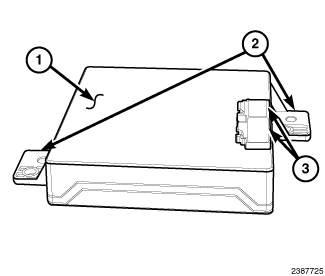
The Passive Entry Module (PEM) (1) is the primary component of the Passive Entry (PE) and Keyless Go (KG) systems. The PEM contains both the Central Processor Unit (CPU) and transceiver of the PE and KG systems, and is sometimes alternately referred to as the PEKG module or receiver. Concealed within the molded black plastic PEM housing is the printed circuit board and the other electronic circuitry of the module.
The PEM is secured with two screws to the substrate on the back of the instrument panel base trim, above the upper glove box opening near the passenger airbag retainer or chute. Two mounting tabs (2) at opposing corners and two connector receptacles (3) are integral to the PEM housing. The connector receptacles contain all of the terminal pins that connect the PEM to the vehicle electrical system through two dedicated take outs and connectors of the instrument panel wire harness.
There are at least two unique hardware versions of the PEM. These versions are required in order to accommodate the two Controller Area Network (CAN) data bus systems possibly found in Chrysler vehicles, CAN-B or CAN-Interior High Speed (IHS). The PEM used for this platform must be able to communicate with other electronic modules in the vehicle using the CAN-B data bus network.
The PEM cannot be adjusted or repaired and, if damaged or ineffective, it must be replaced. The PEM software is flash programmable.
Factory Service Tools
Use the Manual With the Right Hardware
Pair factory procedures with proven DIY tools so the instructions are easier to execute.
Disclosure: Verified tool recommendations may earn an affiliate commission at no cost to you.
When to See a Mechanic
Stop DIY work and contact a certified mechanic immediately if any of the following apply:
- • You smell fuel, burning insulation, or see smoke.
- • Brakes feel soft, pull hard to one side, or make grinding noises.
- • The engine overheats, stalls repeatedly, or misfires under load.
- • You are missing required tools, torque specs, or safe lifting equipment.
- • You are not confident in the next step or safety outcome.