
Safety Warning
DIY auto repair can cause serious injury, fire, or vehicle damage. These guides are for informational purposes only. Always follow OEM torque specs, wear PPE, and consult a certified mechanic if you are unsure. You are solely responsible for your safety.
2000 Chrysler Neon (CANADA) L4-2.0LFACTORY OEM SERVICE PROCEDURE
Coolant Temperature Sensor/Switch (For Computer): Description and Operation
ENGINE COOLANT TEMPERATURE SENSOR PCM INPUT
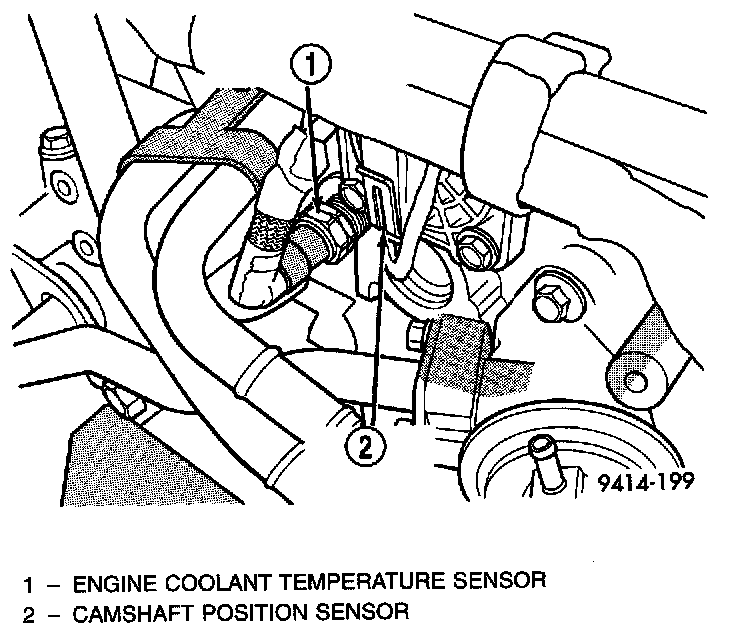
The coolant sensor threads into the rear of the cylinder head, next to the camshaft position sensor. New sensors have sealant applied to the threads.
The ECT Sensor is a Negative Thermal Coefficient (NTC), dual range Sensor. The resistance of the ECT Sensor changes as coolant temperature changes. This results in different input voltages to the PCM. The PCM also uses the ECT Sensor input to operate the low and high speed radiator cooling fans.
The combination coolant temperature sensor has two elements. One element supplies coolant temperature signal to the PCM. The other element supplies coolant temperature signal to the instrument panel gauge cluster. The PCM determines engine coolant temperature from the coolant temperature sensor.
As coolant temperature varies the coolant temperature sensors resistance changes resulting in a different input voltage to the PCM and the instrument panel gauge cluster.
When the engine is cold, the PCM will provide slightly richer air-fuel mixtures and higher idle speeds until normal operating temperatures are reached.
The PCM has a dual temperature range program for better sensor accuracy at cold temperatures. At key-ON the PCM sends a regulated five volt signal through a 10,000 ohm resistor to the sensor. When the sensed voltage reaches approximately 1.25 volts the PCM turns on the transistor. The transistor connects a 1,000 ohm resistor in parallel with the 10,000 ohm resistor. With this drop in resistance the PCM recognizes an increase in voltage on the input circuit.
Engine Coolant Temperature Sensor (SOHC):
The coolant sensor threads into the rear of the cylinder head, next to the camshaft position sensor. New sensors have sealant applied to the threads.
The ECT Sensor is a Negative Thermal Coefficient (NTC), dual range Sensor. The resistance of the ECT Sensor changes as coolant temperature changes. This results in different input voltages to the PCM. The PCM also uses the ECT Sensor input to operate the low and high speed radiator cooling fans.
The combination coolant temperature sensor has two elements. One element supplies coolant temperature signal to the PCM. The other element supplies coolant temperature signal to the instrument panel gauge cluster. The PCM determines engine coolant temperature from the coolant temperature sensor.
As coolant temperature varies the coolant temperature sensors resistance changes resulting in a different input voltage to the PCM and the instrument panel gauge cluster.
When the engine is cold, the PCM will provide slightly richer air-fuel mixtures and higher idle speeds until normal operating temperatures are reached.
The PCM has a dual temperature range program for better sensor accuracy at cold temperatures. At key-ON the PCM sends a regulated five volt signal through a 10,000 ohm resistor to the sensor. When the sensed voltage reaches approximately 1.25 volts the PCM turns on the transistor. The transistor connects a 1,000 ohm resistor in parallel with the 10,000 ohm resistor. With this drop in resistance the PCM recognizes an increase in voltage on the input circuit.
Factory Service Tools
Use the Manual With the Right Hardware
Pair factory procedures with proven DIY tools so the instructions are easier to execute.
Disclosure: Verified tool recommendations may earn an affiliate commission at no cost to you.
When to See a Mechanic
Stop DIY work and contact a certified mechanic immediately if any of the following apply:
- • You smell fuel, burning insulation, or see smoke.
- • Brakes feel soft, pull hard to one side, or make grinding noises.
- • The engine overheats, stalls repeatedly, or misfires under load.
- • You are missing required tools, torque specs, or safe lifting equipment.
- • You are not confident in the next step or safety outcome.
Rather have a pro handle this?
A certified mobile mechanic comes to your home or office. They bring the tools, you stay comfortable. No tow truck, no waiting room, no surprises.
Comes to youSame-day available12-month warranty
Get a Free QuoteNo obligation. See pricing before you book.