
Safety Warning
DIY auto repair can cause serious injury, fire, or vehicle damage. These guides are for informational purposes only. Always follow OEM torque specs, wear PPE, and consult a certified mechanic if you are unsure. You are solely responsible for your safety.
2000 Chrysler Neon (CANADA) L4-2.0LFACTORY OEM SERVICE PROCEDURE
Power Distribution Module: Description and Operation
POWER DISTRIBUTION CENTER (PDC)
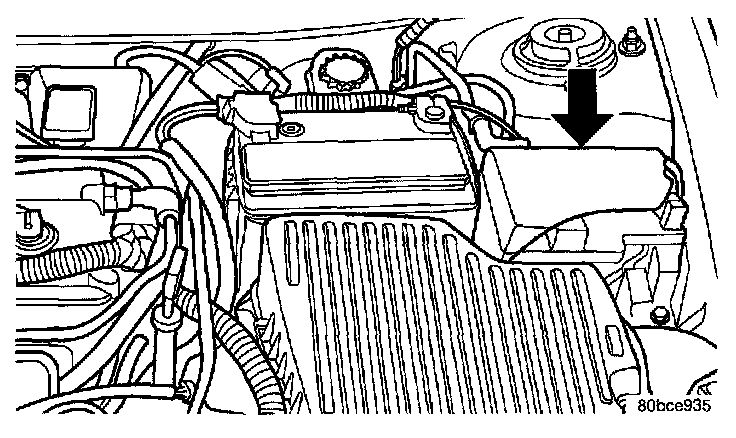
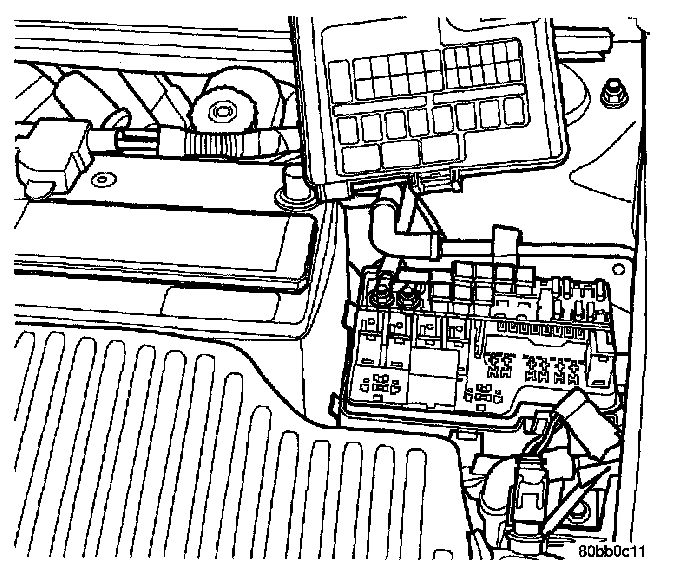
All of the electrical current distributed throughout this vehicle is directed through the standard equipment Power Distribution Center (PDC). The molded plastic PDC housing is located in the left front corner of the engine compartment, just behind the air cleaner housing and to the left of the battery. The PDC housing has a molded plastic cover. The PDC cover is easily removed for service access and has a convenient fuse and relay layout label affixed to the inside surface of the cover to ensure proper component identification.
The PDC contains the starter relay, radiator fan relay, A/C compressor clutch relay, auto shutdown relay, fuel pump relay and several fuses.
The PDC housing is secured to the left inner fender well an indexing pin and one screw. All of the PDC outputs are through the integral engine compartment wire harness.
All of the current from the generator cable connection goes to the battery through a 140 ampere fusible link that is secured with a nut to the positive battery cable terminal. The PDC houses up to ten six fuse cartridges, which replace all in-line fusible links. The PDC also houses up to twelve blade-type fuses, up to three full International Standards Organization (ISO) relays, and up to eight mini International Standards Organization (ISO) relays. Internal connection of all the PDC circuits is accomplished by an intricate network of hard wiring and bus bars.
The fusible link, fuses and relays are available for service replacement. The PDC unit cannot be repaired and is only serviced as a unit with the engine compartment wire harness. If the PDC is faulty or damaged, the engine compartment wire harness assembly must be replaced.
Power Distribution Center (PDC) Location:
Power Distribution Center (PDC):
All of the electrical current distributed throughout this vehicle is directed through the standard equipment Power Distribution Center (PDC). The molded plastic PDC housing is located in the left front corner of the engine compartment, just behind the air cleaner housing and to the left of the battery. The PDC housing has a molded plastic cover. The PDC cover is easily removed for service access and has a convenient fuse and relay layout label affixed to the inside surface of the cover to ensure proper component identification.
The PDC contains the starter relay, radiator fan relay, A/C compressor clutch relay, auto shutdown relay, fuel pump relay and several fuses.
The PDC housing is secured to the left inner fender well an indexing pin and one screw. All of the PDC outputs are through the integral engine compartment wire harness.
All of the current from the generator cable connection goes to the battery through a 140 ampere fusible link that is secured with a nut to the positive battery cable terminal. The PDC houses up to ten six fuse cartridges, which replace all in-line fusible links. The PDC also houses up to twelve blade-type fuses, up to three full International Standards Organization (ISO) relays, and up to eight mini International Standards Organization (ISO) relays. Internal connection of all the PDC circuits is accomplished by an intricate network of hard wiring and bus bars.
The fusible link, fuses and relays are available for service replacement. The PDC unit cannot be repaired and is only serviced as a unit with the engine compartment wire harness. If the PDC is faulty or damaged, the engine compartment wire harness assembly must be replaced.
Factory Service Tools
Use the Manual With the Right Hardware
Pair factory procedures with proven DIY tools so the instructions are easier to execute.
Disclosure: Verified tool recommendations may earn an affiliate commission at no cost to you.
When to See a Mechanic
Stop DIY work and contact a certified mechanic immediately if any of the following apply:
- • You smell fuel, burning insulation, or see smoke.
- • Brakes feel soft, pull hard to one side, or make grinding noises.
- • The engine overheats, stalls repeatedly, or misfires under load.
- • You are missing required tools, torque specs, or safe lifting equipment.
- • You are not confident in the next step or safety outcome.
Rather have a pro handle this?
A certified mobile mechanic comes to your home or office. They bring the tools, you stay comfortable. No tow truck, no waiting room, no surprises.
Comes to youSame-day available12-month warranty
Get a Free QuoteNo obligation. See pricing before you book.