
Safety Warning
DIY auto repair can cause serious injury, fire, or vehicle damage. These guides are for informational purposes only. Always follow OEM torque specs, wear PPE, and consult a certified mechanic if you are unsure. You are solely responsible for your safety.
2000 Chrysler Intrepid (CANADA) V6-3.2LFACTORY OEM SERVICE PROCEDURE
Window Defogger System Test
Grid Line Test:
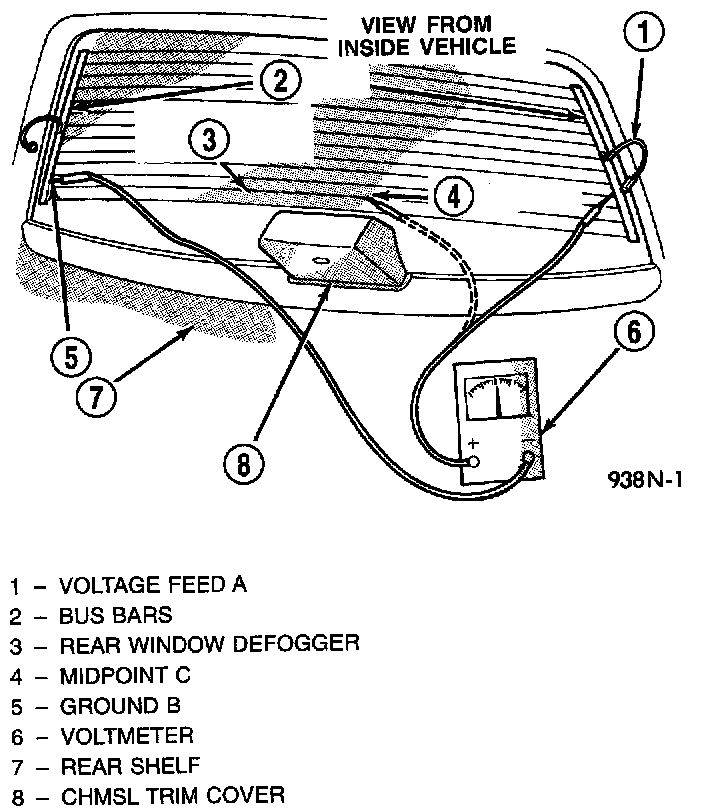
1. Start engine. With the engine running, push the Rear Window Defogger button on the ATC or Manual A/C Heater Control Head. The button LED indicator should light. If the EBL indicator does not light on the MANUAL-A/C HEATER CONTROL, then there may be a wiring problem. This may also indicate that the BCM will not complete the circuit to ground that is required to energize the EBL relay coil (non-ATC vehicles only). Refer to EBL Relay Test. On ATC vehicles, the LED indicator may light when the BCM failed to complete the circuit to ground required to energize the EBL relay coil.
2. Using a DC voltmeter with a 0 - 15 volt range, connect the negative lead to a known good vehicle electrical ground.
3. Touch the positive bus bar and check voltage. The voltage should be above 11 volts. Push the Rear Window Defogger button to turn off the indicator. The measured voltage should be 0 volts. If these voltages are correct then the problem is with the Rear Window Grid or Grid ground electrical connection. Go to the Grid Lines test to check the Grid and ground connection. If there is no voltage to the rear window defogger grid when the system is ON, then go to the Fuse and Electrical Short Test.
Factory Service Tools
Use the Manual With the Right Hardware
Pair factory procedures with proven DIY tools so the instructions are easier to execute.
Disclosure: Verified tool recommendations may earn an affiliate commission at no cost to you.
When to See a Mechanic
Stop DIY work and contact a certified mechanic immediately if any of the following apply:
- • You smell fuel, burning insulation, or see smoke.
- • Brakes feel soft, pull hard to one side, or make grinding noises.
- • The engine overheats, stalls repeatedly, or misfires under load.
- • You are missing required tools, torque specs, or safe lifting equipment.
- • You are not confident in the next step or safety outcome.