
Safety Warning
DIY auto repair can cause serious injury, fire, or vehicle damage. These guides are for informational purposes only. Always follow OEM torque specs, wear PPE, and consult a certified mechanic if you are unsure. You are solely responsible for your safety.
2000 Chrysler Intrepid (CANADA) V6-3.2LFACTORY OEM SERVICE PROCEDURE
Battery Charging
WARNING: DO NOT CHARGE A BATTERY THAT HAS EXCESSIVELY LOW ELECTROLYTE LEVEL.BATTERY MAY SPARK INTERNALLY AND EXPLODE. EXPLOSIVE GASES FORM OVER THE BATTERY. DO NOT SMOKE, USE FLAME, OR CREATE SPARKS NEAR BATTERY. DO NOT ASSIST BOOST OR CHARGE A FROZEN BATTERY. BATTERY CASING MAY FRACTURE. BATTERY ACID IS POISON, AND MAY CAUSE SEVERE BURNS. BATTERIES CONTAIN SULFURIC ACID. AVOID CONTACT WITH SKIN, EYES, OR CLOTHING. IN THE EVENT OF CONTACT, FLUSH WITH WATER AND CALL PHYSICIAN IMMEDIATELY. KEEP OUT OF REACH OF CHILDREN.
CAUTION: Disconnect the NEGATIVE battery cable remote terminal first before charging battery to avoid damage to electrical systems. Do not exceed 16.0 volts while charging battery. Refer to the instructions supplied with charging equipment
NOTE: The battery cannot be refilled with water, it must be replaced.
A battery is considered fully charged when it will meet all the following requirements.
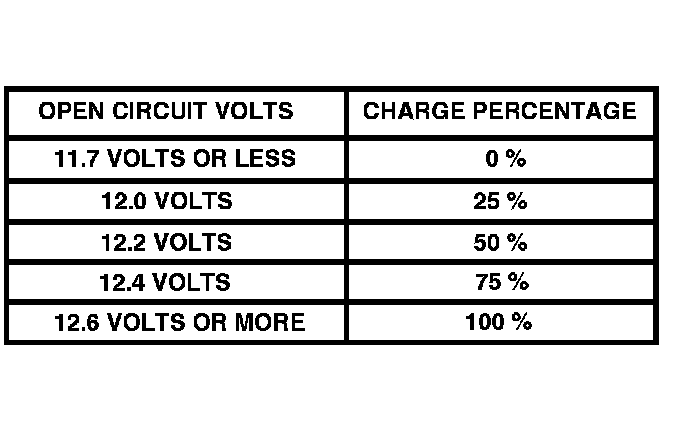
- It has an open circuit voltage charge of at least 12.4 volts. Refer to Battery Open Circuit Voltage table.
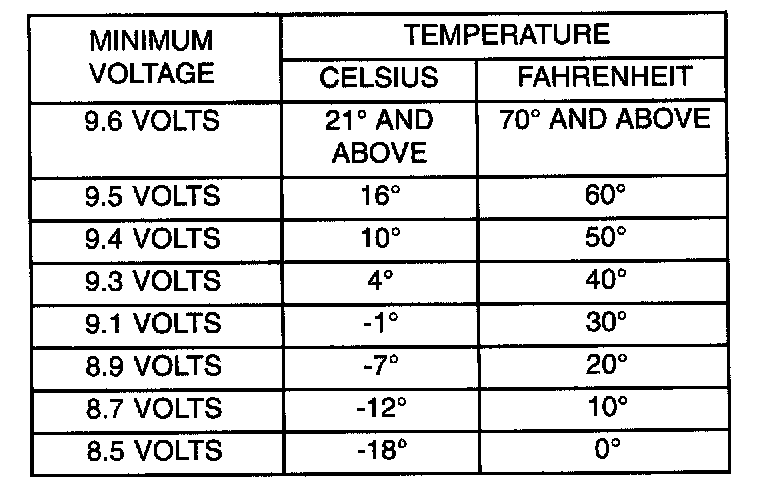
- It passes the 15 second load test, refer to the Load Test Temperature chart.
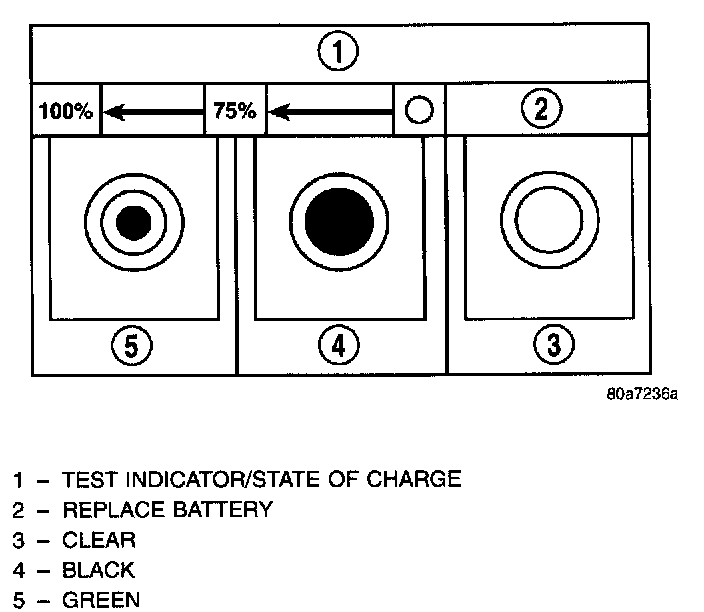
- The built in test indicator dot is GREEN.
Battery electrolyte will bubble inside of battery case while being charged properly. If the electrolyte boils violently, or is discharged from the vent holes while charging, immediately reduce charging rate or turn off charger. Evaluate battery condition. Battery damage may occur if charging is excessive.
Some battery chargers are equipped with polarity sensing devices to protect the charger or battery from being damaged if improperly connected. If the battery state of charge is too low for the polarity sensor to detect, the sensor must be bypassed for charger to operate. Refer to operating instructions provided with battery charger being used.
CAUTION: Charge battery until test indicator appears green. Do not overcharge.
It may be necessary to jiggle the battery or vehicle to bring the green dot in the test indicator into view.
After the battery has been charged to 12.4 volts or greater, perform a load test to determine cranking capacity. Refer to Battery Load Test. If the battery passes the load test, return the battery to use. If battery will not endure a load test, it must be replaced. Properly clean and inspect battery hold downs, tray, terminals, cables, posts, and top before completing service.
CAUTION: Disconnect the NEGATIVE battery cable remote terminal first before charging battery to avoid damage to electrical systems. Do not exceed 16.0 volts while charging battery. Refer to the instructions supplied with charging equipment
NOTE: The battery cannot be refilled with water, it must be replaced.
A battery is considered fully charged when it will meet all the following requirements.
Battery Open Circuit Voltage:
- It has an open circuit voltage charge of at least 12.4 volts. Refer to Battery Open Circuit Voltage table.
Load Test Temperature:
- It passes the 15 second load test, refer to the Load Test Temperature chart.
Reading Test Indicator:
- The built in test indicator dot is GREEN.
Battery electrolyte will bubble inside of battery case while being charged properly. If the electrolyte boils violently, or is discharged from the vent holes while charging, immediately reduce charging rate or turn off charger. Evaluate battery condition. Battery damage may occur if charging is excessive.
Some battery chargers are equipped with polarity sensing devices to protect the charger or battery from being damaged if improperly connected. If the battery state of charge is too low for the polarity sensor to detect, the sensor must be bypassed for charger to operate. Refer to operating instructions provided with battery charger being used.
CAUTION: Charge battery until test indicator appears green. Do not overcharge.
It may be necessary to jiggle the battery or vehicle to bring the green dot in the test indicator into view.
After the battery has been charged to 12.4 volts or greater, perform a load test to determine cranking capacity. Refer to Battery Load Test. If the battery passes the load test, return the battery to use. If battery will not endure a load test, it must be replaced. Properly clean and inspect battery hold downs, tray, terminals, cables, posts, and top before completing service.
Factory Service Tools
Use the Manual With the Right Hardware
Pair factory procedures with proven DIY tools so the instructions are easier to execute.
Disclosure: Verified tool recommendations may earn an affiliate commission at no cost to you.
When to See a Mechanic
Stop DIY work and contact a certified mechanic immediately if any of the following apply:
- • You smell fuel, burning insulation, or see smoke.
- • Brakes feel soft, pull hard to one side, or make grinding noises.
- • The engine overheats, stalls repeatedly, or misfires under load.
- • You are missing required tools, torque specs, or safe lifting equipment.
- • You are not confident in the next step or safety outcome.