
Safety Warning
DIY auto repair can cause serious injury, fire, or vehicle damage. These guides are for informational purposes only. Always follow OEM torque specs, wear PPE, and consult a certified mechanic if you are unsure. You are solely responsible for your safety.
2012 Chevrolet Caprice PPV V6-3.6LFACTORY OEM SERVICE PROCEDURE
Alignment: Testing and Inspection
Trim Height Inspection
Trim Height Measurement
Trim height is a predetermined measurement relating to vehicle ride height. Incorrect trim heights can cause the vehicle to bottom out over bumps causing damage to the suspension components and symptoms similar to wheel alignment concerns. Check the trim heights when diagnosing suspension concerns and before checking the wheel alignment.
The vehicle must be on a flat level surface and all dimensions must be measured vertical from the ground. Trim heights should be within 13 mm (0.51 in) to be considered correct.
The suspension and trim height dimensions are for standard vehicles with base equipment only. The dimensions are for a new vehicle built to standard specification and are intended as a guide when checking trim height dimensions at normal curb weight.
Perform the following before measuring the trim heights:
* Check the tire pressures. Refer to Tire Inflation Pressure Specifications [1][2]Specifications.
* Check the fuel level. Add additional weight if necessary to simulate a full tank.
* Make sure the passenger and rear compartments are empty, except for the spare tire.
* Make sure the vehicle is on a flat and level surface, such as an alignment rack.
* Check that all the vehicle doors are securely closed.
* Check that the vehicle hood and trunk are securely closed.
* Check for installed after market accessories or modifications that could affect trim height measurement.
Measuring the trim height
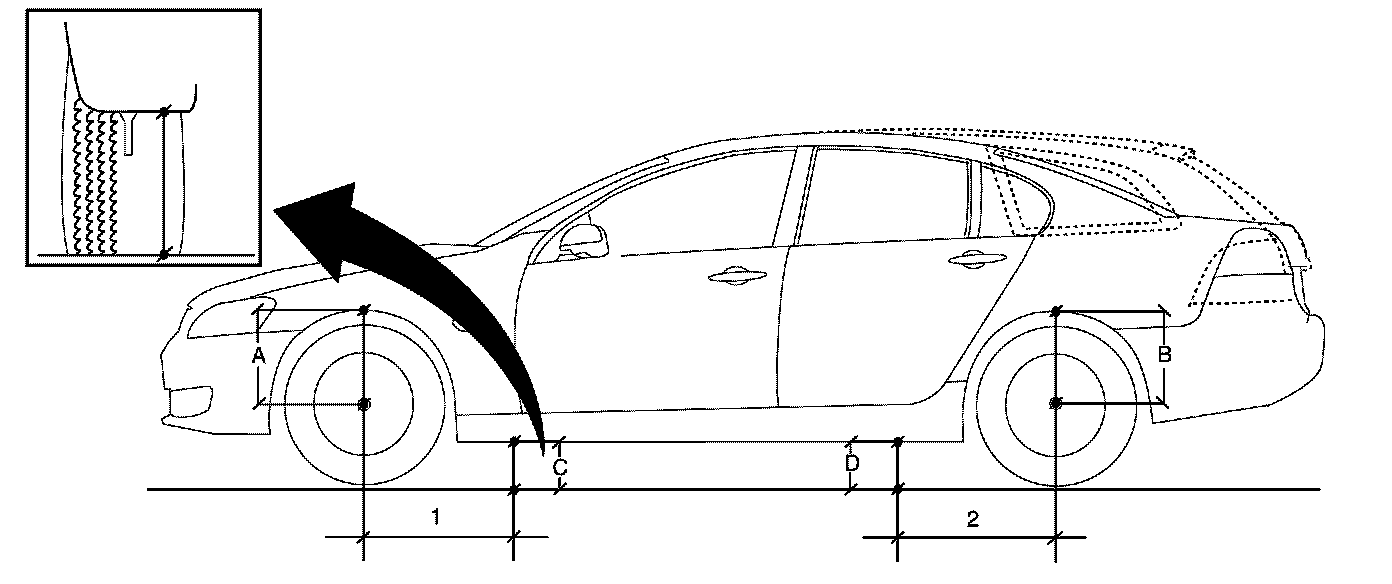
Important:
The vehicle must be on a flat level surface
1. Using your hands, lift the front bumper approximately 38 mm (1.49 in).
2. Gently remove your hands and allow the vehicle to lower.
3. Using your hands, bounce the front of the vehicle downward approximately 38 mm (1.49 in).
4. Gently remove your hands and allow the vehicle to rise.
5. Measure and note the C dimension for the left and right side of the vehicle, inboard of the pinch-weld flange at 544 mm (21.42 in) (1) from the centerline of the front wheel.
6. Measure and note the A dimension for the left and right side of the vehicle from the bottom of the front wheel rim to the wheel arc along the centerline of the front wheel.
7. Using your hands, lift the front bumper approximately 38 mm (1.49 in).
8. Gently remove your hands and allow the vehicle to lower.
9. Using your hands, bounce the front of the vehicle downward approximately 38 mm (1.49 in).
10. Gently remove your hands and allow the vehicle to rise.
11. Measure and note the D dimension for the left and right side of the vehicle, inboard of the pinch-weld flange at 544 mm (21.42 in) (1) from the centerline of the rear wheel.
12. Measure and note the B dimension for the left and right side of the vehicle from the bottom of the rear wheel rim to the wheel arc along the centerline of the rear wheel.
13. Compare the A, B, C and D dimension measurements to the trim height specifications. Refer to Trim Height Specifications Trim Height Specifications.
14. Compare the right and left and front and rear dimension measurements to the trim height variation specifications. Refer to Trim Height Specifications Trim Height Specifications.
15. If the measurements are not within the specified range, replace the coil springs as required.
Factory Service Tools
Use the Manual With the Right Hardware
Pair factory procedures with proven DIY tools so the instructions are easier to execute.
Disclosure: Verified tool recommendations may earn an affiliate commission at no cost to you.
When to See a Mechanic
Stop DIY work and contact a certified mechanic immediately if any of the following apply:
- • You smell fuel, burning insulation, or see smoke.
- • Brakes feel soft, pull hard to one side, or make grinding noises.
- • The engine overheats, stalls repeatedly, or misfires under load.
- • You are missing required tools, torque specs, or safe lifting equipment.
- • You are not confident in the next step or safety outcome.