
Safety Warning
DIY auto repair can cause serious injury, fire, or vehicle damage. These guides are for informational purposes only. Always follow OEM torque specs, wear PPE, and consult a certified mechanic if you are unsure. You are solely responsible for your safety.
2008 Chevrolet Uplander V6-3.9LFACTORY OEM SERVICE PROCEDURE
Electronic Compass Calibration
Electronic Compass Calibration
Compass Calibration
The compass is self calibrating but under certain circumstances the compass may have to be calibrated especially if the vehicle is driven over long distances. If the compass heading is blank or the driver information center (DIC) shows CAL, the compass must be re-calibrated.
Depress the Menu button to get to the COMPASS ZONE item. Depress the Set/Reset button to scroll through the available compass zones. Depress the Menu button to get to the COMPASS CALIBRATION item. To calibrate the compass, depress the Set/Reset button until the CALIBRATION BEGUN DRIVE UNTIL DONE message appears DIC. Drive the vehicle through two circles less than 5 mph in a magnetically clean area. The calibration will be complete when the CALIBRATION FINISHED message is displayed in the DIC.
Compass Magnetic Variation Adjustment
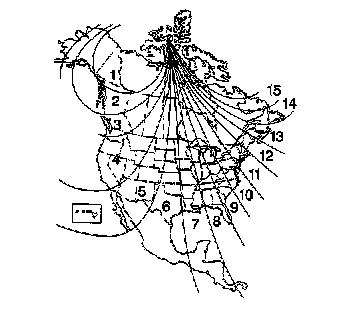
Compass variation is the difference between magnetic north and geographic north. In some areas of the country the difference is great enough to cause the compass to give a false reading. If this occurs, the compass variance must be set. View the variance zone map to determine the correct zone. The zones are numbered 1 through 15. While the DIC is in the COMPASS ZONE item, the DIC will display the current compass zone. Depressing the Set/Reset button will scroll through the available compass zones. Depressing the Set/Reset button for a few seconds will select the displayed compass zone.
You cannot reset the Compass/Temperature mode. This mode is retained during ignition OFF.
Factory Service Tools
Use the Manual With the Right Hardware
Pair factory procedures with proven DIY tools so the instructions are easier to execute.
Disclosure: Verified tool recommendations may earn an affiliate commission at no cost to you.
When to See a Mechanic
Stop DIY work and contact a certified mechanic immediately if any of the following apply:
- • You smell fuel, burning insulation, or see smoke.
- • Brakes feel soft, pull hard to one side, or make grinding noises.
- • The engine overheats, stalls repeatedly, or misfires under load.
- • You are missing required tools, torque specs, or safe lifting equipment.
- • You are not confident in the next step or safety outcome.