
Safety Warning
DIY auto repair can cause serious injury, fire, or vehicle damage. These guides are for informational purposes only. Always follow OEM torque specs, wear PPE, and consult a certified mechanic if you are unsure. You are solely responsible for your safety.
2007 Chevrolet Express 3500 V8-4.8LFACTORY OEM SERVICE PROCEDURE
Intake Manifold/Upper Engine
Disassembled Views
Intake Manifold/Upper Engine:
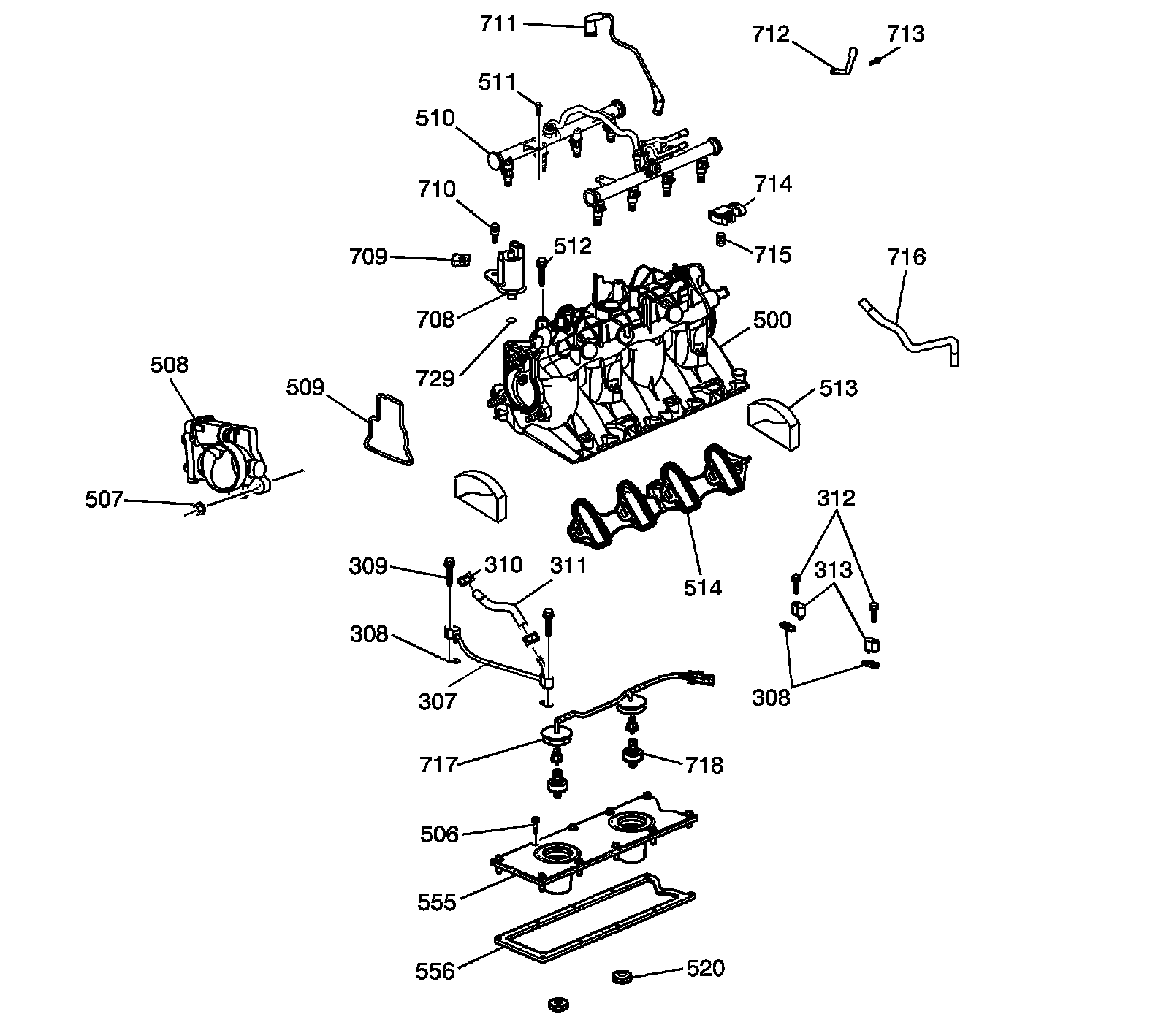
307 - Engine Coolant Air Bleed Pipe
308 - Engine Coolant Air Bleed Pipe/Cover Seal
308 - Engine Coolant Air Bleed Pipe/Cover Seal
309 - Engine Coolant Air Bleed Pipe Bolt
310 - Engine Coolant Air Bleed Hose Clamp
311 - Engine Coolant Air Bleed Hose
312 - Engine Coolant Air Bleed Cover Bolt
313 - Engine Coolant Air Bleed Cover
500 - Intake Manifold
506 - Valley Cover Bolt
507 - Throttle Body Nut
508 - Throttle Body
509 - Throttle Body Gasket
510 - Fuel Rail with Injectors
511 - Fuel Rail Bolt
512 - Intake Manifold Bolt
513 - Intake Manifold Seal
514 - Intake Manifold Gasket
520 - Knock Sensor Oil Seals
555 - Valley Cover
556 - Valley Cover Gasket
708 - Evaporative Emission (EVAP) Canister Purge Solenoid Valve
709 - EVAP Canister Purge Solenoid Valve Isolator
710 - EVAP Canister Purge Solenoid Valve Bolt
711 - Fuel Pressure Regulator Vacuum Hose - RPO L59
712 - Fuel Rail Stop Bracket
713 - Fuel Rail Stop Bracket Bolt
714 - Manifold Absolute Pressure (MAP) Sensor
715 - MAP Sensor Seal
716 - Positive Crankcase Ventilation (PCV) Hose - Dirty Air
717 - Knock Sensor Wire Harness
718 - Knock Sensor
729 - EVAP Canister Purge Solenoid Valve Seal
Factory Service Tools
Use the Manual With the Right Hardware
Pair factory procedures with proven DIY tools so the instructions are easier to execute.
Disclosure: Verified tool recommendations may earn an affiliate commission at no cost to you.
When to See a Mechanic
Stop DIY work and contact a certified mechanic immediately if any of the following apply:
- • You smell fuel, burning insulation, or see smoke.
- • Brakes feel soft, pull hard to one side, or make grinding noises.
- • The engine overheats, stalls repeatedly, or misfires under load.
- • You are missing required tools, torque specs, or safe lifting equipment.
- • You are not confident in the next step or safety outcome.