
Safety Warning
DIY auto repair can cause serious injury, fire, or vehicle damage. These guides are for informational purposes only. Always follow OEM torque specs, wear PPE, and consult a certified mechanic if you are unsure. You are solely responsible for your safety.
2007 Cadillac XLR V8-4.4L SCFACTORY OEM SERVICE PROCEDURE
Distance Sensor: Adjustments
Distance Sensing Cruise Control Aiming
1. Place a bubble level against the front of the radar. Adjust the vertical control until the radar is level.
2. For horizontal adjustment, measure the back of the horizontal adjuster. Adjust the horizontal until 6 mm (0.25 in) of the adjuster is protruding out behind the radar. This method should work assuming that the bracket and frame have not been damaged in a collision.
3. Use a scan tool to perform a Factory Reset of the adaptive cruise module (ACM). Ensure that the Auto Alignment Learn Status parameter indicates Not Aligned. This allows the forward looking sensor (FLS) to automatically align itself during vehicle driving.
4. Drive the vehicle at speeds of at least 56 kph (35 mph), so that the automatic alignment process can operate. The process requires the radar to observe stationary targets along the edge of the road (i.e. mail boxes, parked cars, poles, signs, etc.). Do not follow other vehicles too closely, since this obscures the view for the radar.
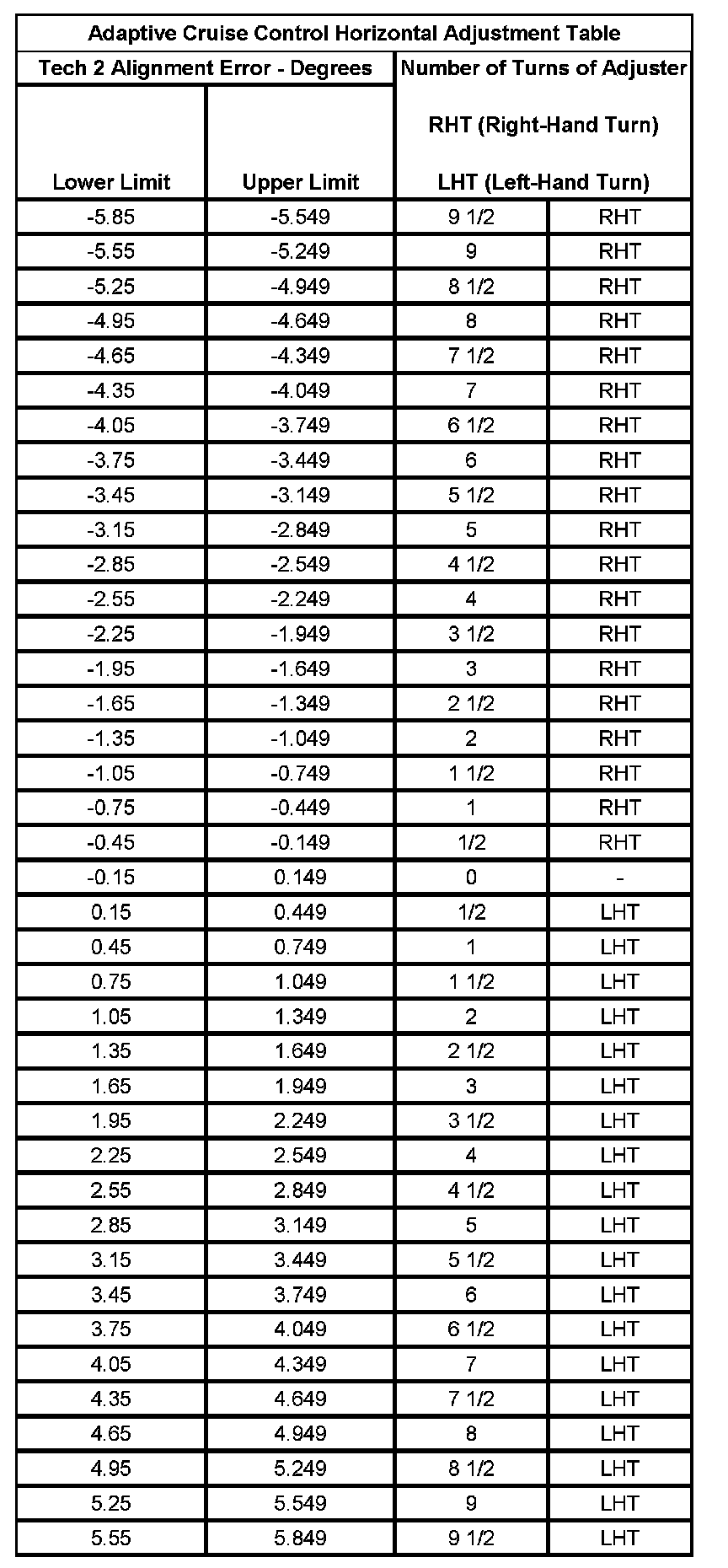
5. Use a scan tool to monitor the Auto Alignment Learn Status parameter. Continue driving until the Auto Alignment Learn Status parameter indicates Aligned. Typically, it will require less than 10 miles of driving. If not proceed to step #4. If the resulting Alignment Error is within -1.5 and 1.5 degrees, the alignment is within specification. Otherwise, proceed to step #6.
6. Adjust the horizontal adjuster according to the Alignment Error chart provided below. Then, repeat steps 3, 4, and 5.
Factory Service Tools
Use the Manual With the Right Hardware
Pair factory procedures with proven DIY tools so the instructions are easier to execute.
Disclosure: Verified tool recommendations may earn an affiliate commission at no cost to you.
When to See a Mechanic
Stop DIY work and contact a certified mechanic immediately if any of the following apply:
- • You smell fuel, burning insulation, or see smoke.
- • Brakes feel soft, pull hard to one side, or make grinding noises.
- • The engine overheats, stalls repeatedly, or misfires under load.
- • You are missing required tools, torque specs, or safe lifting equipment.
- • You are not confident in the next step or safety outcome.