
Safety Warning
DIY auto repair can cause serious injury, fire, or vehicle damage. These guides are for informational purposes only. Always follow OEM torque specs, wear PPE, and consult a certified mechanic if you are unsure. You are solely responsible for your safety.
1982 Cadillac Seville V6-252 4.1LFACTORY OEM SERVICE PROCEDURE
Rear Wheel Alignment
Camber & Toe-In
Camber and toe-in are checked at the same time following the procedure outlined below. Camber is factory set and is not adjustable. If camber deviates from specified settings, check for a bent control arm or frame, or for a improperly mounted hub and bearing assembly.
1. Check front and rear trim heights.
2. Check automatic level control system, if equipped, for proper operation.
Fig. 4 Checking vehicle for squareness on alignment rack:
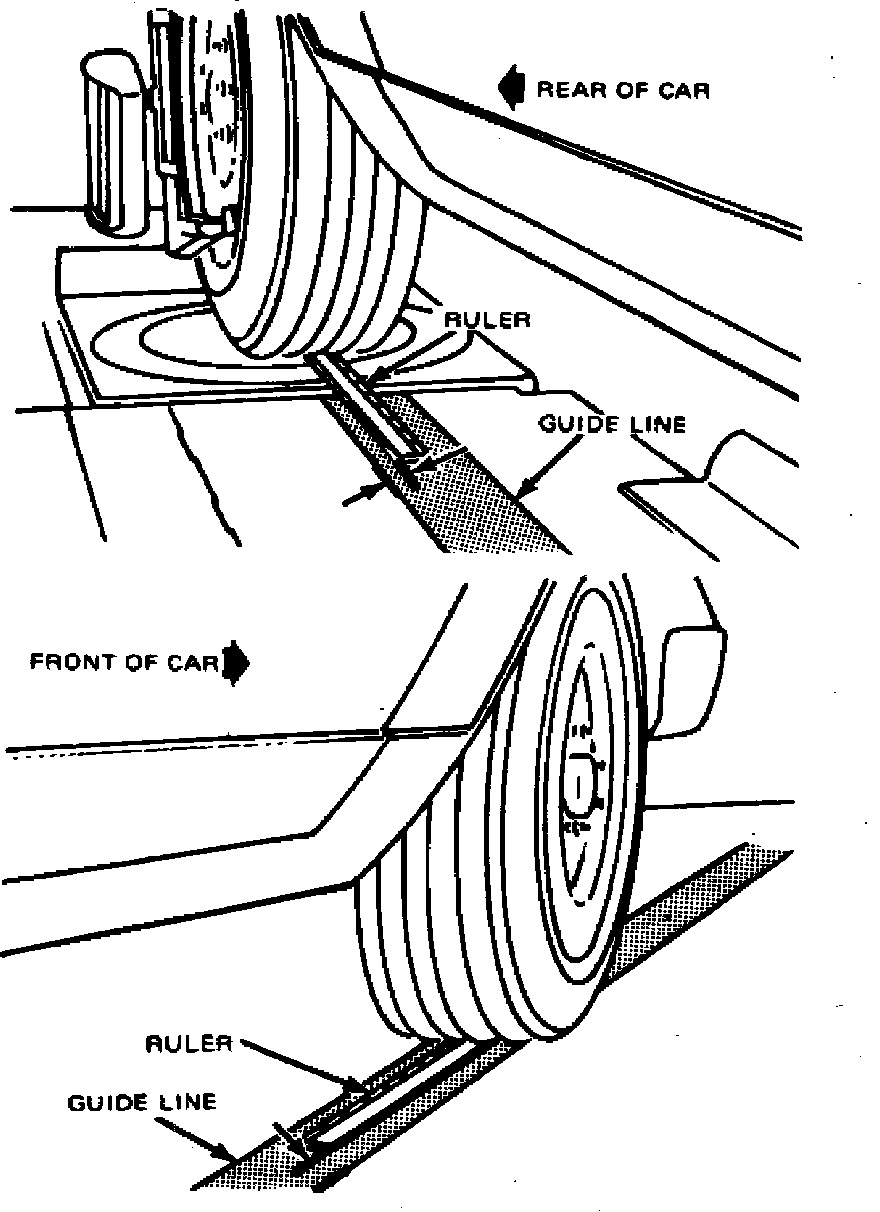
3. Position vehicle on alignment rack as follows:
a. Place masking tape on floor from wheel plate to rear of vehicle to use as a guide to square vehicle on alignment rack.
b. Back rear of vehicle onto rack, positioning wheels on wheel plates.
c. Place a ruler at same rib of tire at front and rear of vehicle, then measure distance from inside edge of ruler to edge of guide line, Fig. 4. When vehicle is square, measurement from guide line to ruler should be greater at rear tire by approximately 5/8 inch.
4. Attach alignment mirrors to rear wheels, then check camber and toe settings and compare to specifications. When vehicle is backed onto alignment rack, toe-in and toe-out are reversed. That is, toe-in will be read as toe-out, while toe-out will be read as toe-in.
5. As stated previously, camber is not adjustable. To adjust toe-in, loosen inner pivot bushing retaining nut and bolt. Move control arm rearward to increase toe-in, or toward front of vehicle to decrease toe-in. A pry bar can be used to facilitate adjustment. After adjustment is completed, torque bushing retaining nut to 70 ft. lbs.
Factory Service Tools
Use the Manual With the Right Hardware
Pair factory procedures with proven DIY tools so the instructions are easier to execute.
Disclosure: Verified tool recommendations may earn an affiliate commission at no cost to you.
When to See a Mechanic
Stop DIY work and contact a certified mechanic immediately if any of the following apply:
- • You smell fuel, burning insulation, or see smoke.
- • Brakes feel soft, pull hard to one side, or make grinding noises.
- • The engine overheats, stalls repeatedly, or misfires under load.
- • You are missing required tools, torque specs, or safe lifting equipment.
- • You are not confident in the next step or safety outcome.