
Safety Warning
DIY auto repair can cause serious injury, fire, or vehicle damage. These guides are for informational purposes only. Always follow OEM torque specs, wear PPE, and consult a certified mechanic if you are unsure. You are solely responsible for your safety.
1995 Buick LeSabre V6-3.8L VIN KFACTORY OEM SERVICE PROCEDURE
Engine Control Module: Description and Operation
Powertrain Control Module (PCM):
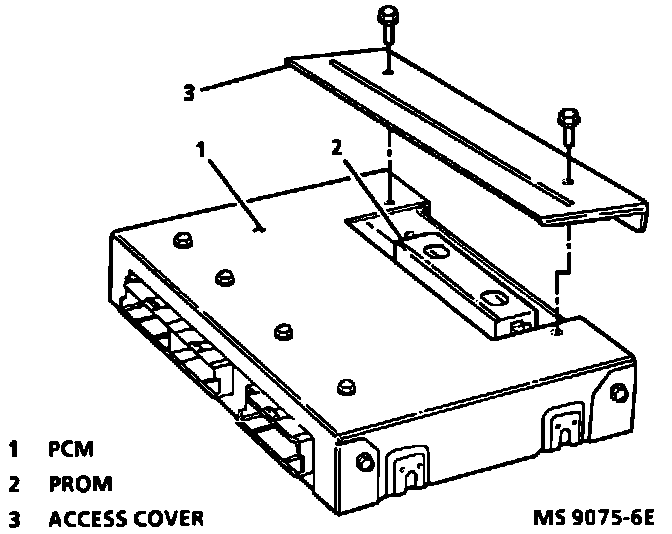
PURPOSE
The Powertrain Control Module (PCM), located under the instrument panel, is the control center of the vehicle. It controls the following:
^ Fuel metering system.
^ Transaxle shifting.
^ Cruise control operation.
^ Ignition timing.
It constantly looks at the information from various sensors, and controls the systems that affect vehicle performance. The PCM also performs the diagnostic function of the system. It can recognize operational problems, alert the driver through the Malfunction Indicator Lamp (MIL) (Service Engine Soon), and store diagnostic trouble codes which identify the problem areas to aid the technician in making repairs. For service, the PCM consists of two parts: a controller (the PCM without a PROM) and an assembly called a Programable Read Only Memory (PROM).
PROM
This assembly contains the functions of the PROM, Transmission Position Switch (PRNDL) decoder, Vehicle speed Sensor (VSS) buffer, cruise control module, and Electronic Spark Control (ESC) module used on past GM applications. It contains the calibrations needed for a specific vehicle based on axle ratio, tire size, and other vehicle characteristics.
OPERATION
The PCM supplies either 5 or 12 volts to power various sensors or switches. This is done through resistances in the PCM which are so high in value that a test light will not light when connected to the circuit. In some cases, even an ordinary shop voltmeter will not give an accurate reading because its resistance is too low. Therefore, a 10 megohm input impedance digital voltmeter is required to assure accurate voltage readings. Tool J 39200 meets this requirement.
The PCM controls output circuits such as the injectors, Idle Air Control (IAC), cooling fan relays, etc. by controlling the ground or power feed circuit through transistors or a device called a "Quad-Driver."
Factory Service Tools
Use the Manual With the Right Hardware
Pair factory procedures with proven DIY tools so the instructions are easier to execute.
Disclosure: Verified tool recommendations may earn an affiliate commission at no cost to you.
When to See a Mechanic
Stop DIY work and contact a certified mechanic immediately if any of the following apply:
- • You smell fuel, burning insulation, or see smoke.
- • Brakes feel soft, pull hard to one side, or make grinding noises.
- • The engine overheats, stalls repeatedly, or misfires under load.
- • You are missing required tools, torque specs, or safe lifting equipment.
- • You are not confident in the next step or safety outcome.
Rather have a pro handle this?
A certified mobile mechanic comes to your home or office. They bring the tools, you stay comfortable. No tow truck, no waiting room, no surprises.
Comes to youSame-day available12-month warranty
Get a Free QuoteNo obligation. See pricing before you book.