
Safety Warning
DIY auto repair can cause serious injury, fire, or vehicle damage. These guides are for informational purposes only. Always follow OEM torque specs, wear PPE, and consult a certified mechanic if you are unsure. You are solely responsible for your safety.
1995 Audi 90S, CS V6-2.8L (AFC)FACTORY OEM SERVICE PROCEDURE
Coolant Temperature Sensor/Switch (For Computer): Testing and Inspection
NOTE:
^ For functional testing of the Engine Coolant Temperature (ECT) sensor, Also Refer to On Board Diagnostic, "Read Measuring Value Block" function 08, display group 001, display field 1.
PROCEDURE
- Disconnect ECT sensor harness connector.
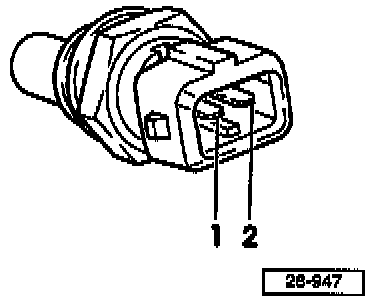
- Check resistance between terminals 1 and 2 of sensor. Specified values:
^ At approx. 20°C (68°F) coolant temperature, approx. 2.5K ohms
^ At approx. 80°C (176°F) coolant temperature, approx. 330 ohms
If specified values are not obtained:
- Replace ECT sensor.
If specified value is obtained, check wiring from sensor to ECM as follows:
- Connect VAG 1598 test box with VAG 1598/11 adapter harness to ECM wiring harness. Connecting VAG 1598/31 Test Box
^ Adapter harness is not connected to ECM.
- Check Ground (GND) wire for continuity between ECT sensor connector terminal 2 and GND.
^ Specified value: maximum 1.0 ohm
- Check signal wire for continuity between ECT sensor connector terminal 1 and test box socket 15.
^ Specified value: maximum 1.0 ohm
- Check both wires for short to each other.
If specified values are not obtained:
- Repair short and/or break in wiring between ECT sensor and ECM connector -C- and/or GND.
ECT sensor ECM connector C
connector terminal terminal
1 15
2 Ground(GND)
If there is no short or break in wiring, and ECT sensor is OK:
- Replace ECM.
^ For functional testing of the Engine Coolant Temperature (ECT) sensor, Also Refer to On Board Diagnostic, "Read Measuring Value Block" function 08, display group 001, display field 1.
PROCEDURE
- Disconnect ECT sensor harness connector.
Engine Coolant Temperature Sensor:
- Check resistance between terminals 1 and 2 of sensor. Specified values:
^ At approx. 20°C (68°F) coolant temperature, approx. 2.5K ohms
^ At approx. 80°C (176°F) coolant temperature, approx. 330 ohms
If specified values are not obtained:
- Replace ECT sensor.
If specified value is obtained, check wiring from sensor to ECM as follows:
- Connect VAG 1598 test box with VAG 1598/11 adapter harness to ECM wiring harness. Connecting VAG 1598/31 Test Box
^ Adapter harness is not connected to ECM.
- Check Ground (GND) wire for continuity between ECT sensor connector terminal 2 and GND.
^ Specified value: maximum 1.0 ohm
- Check signal wire for continuity between ECT sensor connector terminal 1 and test box socket 15.
^ Specified value: maximum 1.0 ohm
- Check both wires for short to each other.
If specified values are not obtained:
- Repair short and/or break in wiring between ECT sensor and ECM connector -C- and/or GND.
ECT sensor ECM connector C
connector terminal terminal
1 15
2 Ground(GND)
If there is no short or break in wiring, and ECT sensor is OK:
- Replace ECM.
Factory Service Tools
Use the Manual With the Right Hardware
Pair factory procedures with proven DIY tools so the instructions are easier to execute.
Disclosure: Verified tool recommendations may earn an affiliate commission at no cost to you.
When to See a Mechanic
Stop DIY work and contact a certified mechanic immediately if any of the following apply:
- • You smell fuel, burning insulation, or see smoke.
- • Brakes feel soft, pull hard to one side, or make grinding noises.
- • The engine overheats, stalls repeatedly, or misfires under load.
- • You are missing required tools, torque specs, or safe lifting equipment.
- • You are not confident in the next step or safety outcome.