
Safety Warning
DIY auto repair can cause serious injury, fire, or vehicle damage. These guides are for informational purposes only. Always follow OEM torque specs, wear PPE, and consult a certified mechanic if you are unsure. You are solely responsible for your safety.
2003 Acura 3.2CL V6-3.2L SOHCFACTORY OEM SERVICE PROCEDURE
A/T Controls - Harsh 2-3 Shift After PCM Replacement
08-045
December 19, 2008
Applies To:
2001-03 3.2CL - ALL
2001-03 3.2CL Type-S - ALL
2000-03 3.2TL - ALL
2002-03 3.2TL Type-S - ALL
Harsh 2-3 Shift Immediately After PCM Replacement
SYMPTOM
A fully warmed-up A/T has a harsh 2-3 shift immediately after PCM replacement.
PROBABLE CAUSE
The replacement PCM does not contain the latest 2-3 shift calibration.
CORRECTIVE ACTION
Replace the PCM.
PARTS INFORMATION
NOTE:
To order the correct PCM, you need to know the vehicle's emissions type (KA or KL). To find the emissions type, do this:
^ From the main menu on your iN workstation, click on SERVICE.
^ From the SERVICE drop-down menu, click on Vehicle Information.
^ From the Vehicle Information drop-down menu, click on VIN Inquiry.
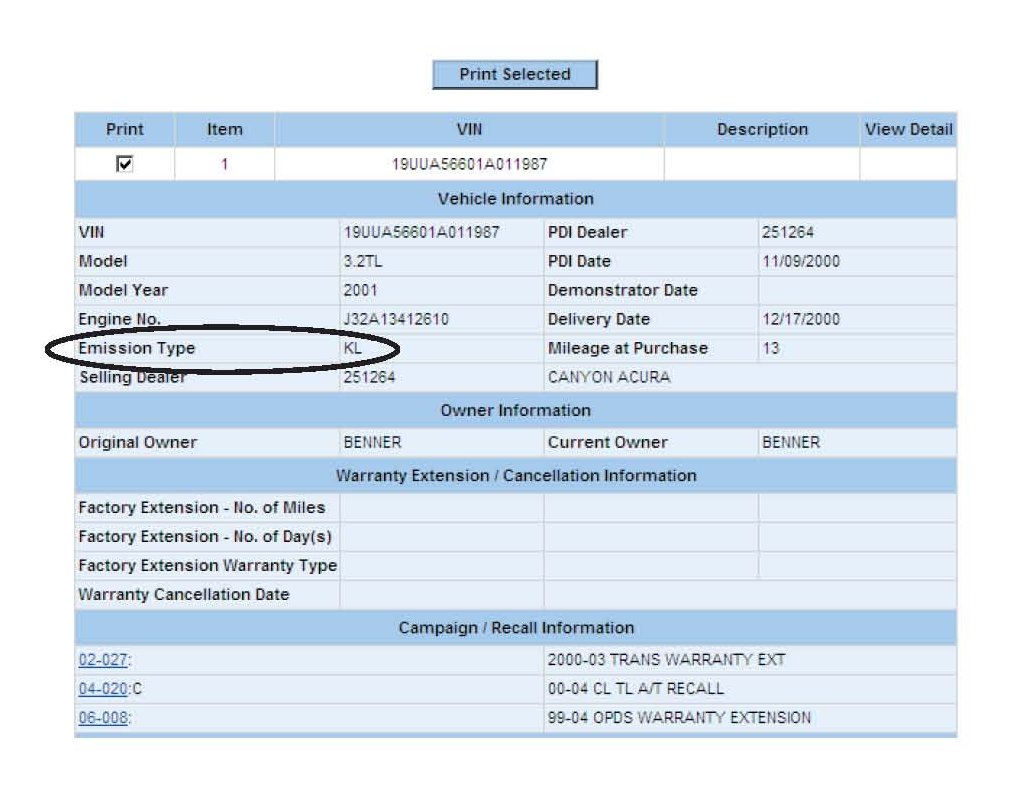
^ Enter the VIN on the VIN Inquiry screen, then click on Submit. You will see the vehicle's emissions type below the engine number.
PCM (powertrain control module):
2001 3.20L (KA), 2000-01 3.2TL (KA) -
P/N 37820-P8E-335
2001 3.20L Type-S (KA, KL) -
P/N 37820-PGE-325
2001 3.20L (KL), 2000-01 3.2TL (KL) -
P/N 37820-P8E-336
2002-03 3.20L (KA), 2002-03 3.2TL (KA) -
P/N 37820-PJE-A65
2002-03 3.20L Type-S (KA, KL),
2002-03 3.2TL Type-S (KA, KL) -
P/N 37820-PGE-A62
2002-03 3.20L (KL), 2002-03 3.2TL (KL) -
P/N 37820-PJE-L65
WARRANTY CLAIM INFORMATION
In warranty:
The normal warranty applies.
Operation Number: 218117
Flat Rate Time: 0.4 hour
Failed Part: P/N 37820-P8E-335
Defect Code: 03217
Symptom Code: 03230
Skill Level: Repair Technician
Out of warranty:
Any repair performed after warranty expiration may be eligible for goodwill consideration by the District Parts and Service Manager or your Zone Office. You must request consideration, and get a decision, before starting work.
REPAIR PROCEDURE
1. Reinstall the original PCM, torque its bolts to 12 N.m (8.7 lb-ft), then go to step 3.
NOTE:
^ The original PCM does not have the letters "RM" at the end of the part number.
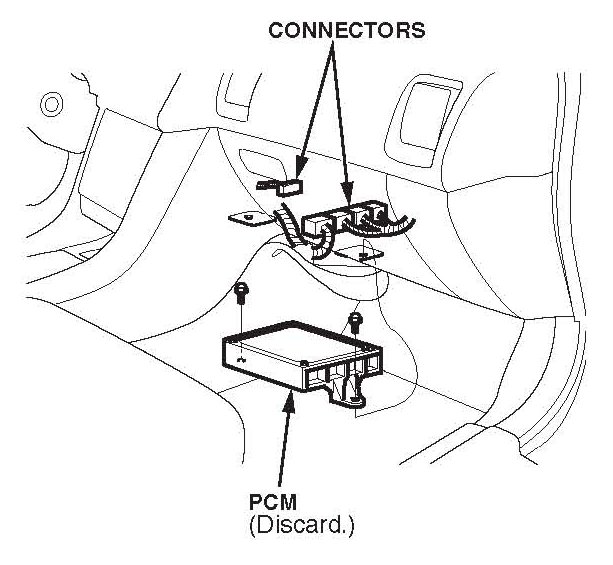
^ If the original PCM is not available, go to step 2.
2. Verify that the currently installed PCM has the correct part number for the vehicle's year, model, and emissions type by comparing its part number to the ones listed under PARTS INFORMATION.
NOTE:
The last three digits of the PCM's part number should match or be higher than the bold- text digits in the part numbers under PARTS INFORMATION.
Does the currently installed PCM have the correct part number for the vehicle's year, model, and emissions type?
Yes - This service bulletin does not apply. Continue with normal troubleshooting to find the cause of the harsh 2-3 shift.
No - Go to step 4.
3. With the transmission fully warmed up, check its 2-3 shift.
Does the transmission shift smoothly?
Yes - Go to step 4.
No - Continue with normal troubleshooting to find the cause of the harsh 2-3 shift.
4. Download the immobilizer key transponder codes from the PCM to the HDS. Refer to REPLACING THE ECM/PCM in Service Bulletin 00-019, Immobilizer System (Type 2).
5. Remove the PCM, and install a new one, torquing its bolts to 12 N.m (8.7 lb-ft).
NOTE:
To order the correct PCM, use the ordering information under PARTS INFORMATION.
6. Upload the immobilizer key transponder codes from the HDS to the new PCM. Refer to REPLACING THE ECM/PCM in Service Bulletin 00-019, Immobilizer System (Type 2).
7. Do the idle learn procedure:
^ Make sure all electrical items (A/C, audio unit, defogger, lights, etc.) are off.
^ Start the engine, and let it warm up to its normal operating temperature (the cooling fan cycles twice).
^ Let the engine idle (throttle fully closed and all electrical items off) for 10 minutes.
8. With the transmission fully warmed up, check its 2-3 shift.
Does the transmission shift smoothly?
Yes - Return the vehicle to the client.
No - Continue with normal troubleshooting to find the cause of the harsh 2-3 shift.

Disclaimer
December 19, 2008
Applies To:
2001-03 3.2CL - ALL
2001-03 3.2CL Type-S - ALL
2000-03 3.2TL - ALL
2002-03 3.2TL Type-S - ALL
Harsh 2-3 Shift Immediately After PCM Replacement
SYMPTOM
A fully warmed-up A/T has a harsh 2-3 shift immediately after PCM replacement.
PROBABLE CAUSE
The replacement PCM does not contain the latest 2-3 shift calibration.
CORRECTIVE ACTION
Replace the PCM.
PARTS INFORMATION
NOTE:
To order the correct PCM, you need to know the vehicle's emissions type (KA or KL). To find the emissions type, do this:
^ From the main menu on your iN workstation, click on SERVICE.
^ From the SERVICE drop-down menu, click on Vehicle Information.
^ From the Vehicle Information drop-down menu, click on VIN Inquiry.
^ Enter the VIN on the VIN Inquiry screen, then click on Submit. You will see the vehicle's emissions type below the engine number.
PCM (powertrain control module):
2001 3.20L (KA), 2000-01 3.2TL (KA) -
P/N 37820-P8E-335
2001 3.20L Type-S (KA, KL) -
P/N 37820-PGE-325
2001 3.20L (KL), 2000-01 3.2TL (KL) -
P/N 37820-P8E-336
2002-03 3.20L (KA), 2002-03 3.2TL (KA) -
P/N 37820-PJE-A65
2002-03 3.20L Type-S (KA, KL),
2002-03 3.2TL Type-S (KA, KL) -
P/N 37820-PGE-A62
2002-03 3.20L (KL), 2002-03 3.2TL (KL) -
P/N 37820-PJE-L65
WARRANTY CLAIM INFORMATION
In warranty:
The normal warranty applies.
Operation Number: 218117
Flat Rate Time: 0.4 hour
Failed Part: P/N 37820-P8E-335
Defect Code: 03217
Symptom Code: 03230
Skill Level: Repair Technician
Out of warranty:
Any repair performed after warranty expiration may be eligible for goodwill consideration by the District Parts and Service Manager or your Zone Office. You must request consideration, and get a decision, before starting work.
REPAIR PROCEDURE
1. Reinstall the original PCM, torque its bolts to 12 N.m (8.7 lb-ft), then go to step 3.
NOTE:
^ The original PCM does not have the letters "RM" at the end of the part number.
^ If the original PCM is not available, go to step 2.
2. Verify that the currently installed PCM has the correct part number for the vehicle's year, model, and emissions type by comparing its part number to the ones listed under PARTS INFORMATION.
NOTE:
The last three digits of the PCM's part number should match or be higher than the bold- text digits in the part numbers under PARTS INFORMATION.
Does the currently installed PCM have the correct part number for the vehicle's year, model, and emissions type?
Yes - This service bulletin does not apply. Continue with normal troubleshooting to find the cause of the harsh 2-3 shift.
No - Go to step 4.
3. With the transmission fully warmed up, check its 2-3 shift.
Does the transmission shift smoothly?
Yes - Go to step 4.
No - Continue with normal troubleshooting to find the cause of the harsh 2-3 shift.
4. Download the immobilizer key transponder codes from the PCM to the HDS. Refer to REPLACING THE ECM/PCM in Service Bulletin 00-019, Immobilizer System (Type 2).
5. Remove the PCM, and install a new one, torquing its bolts to 12 N.m (8.7 lb-ft).
NOTE:
To order the correct PCM, use the ordering information under PARTS INFORMATION.
6. Upload the immobilizer key transponder codes from the HDS to the new PCM. Refer to REPLACING THE ECM/PCM in Service Bulletin 00-019, Immobilizer System (Type 2).
7. Do the idle learn procedure:
^ Make sure all electrical items (A/C, audio unit, defogger, lights, etc.) are off.
^ Start the engine, and let it warm up to its normal operating temperature (the cooling fan cycles twice).
^ Let the engine idle (throttle fully closed and all electrical items off) for 10 minutes.
8. With the transmission fully warmed up, check its 2-3 shift.
Does the transmission shift smoothly?
Yes - Return the vehicle to the client.
No - Continue with normal troubleshooting to find the cause of the harsh 2-3 shift.
Disclaimer
Factory Service Tools
Use the Manual With the Right Hardware
Pair factory procedures with proven DIY tools so the instructions are easier to execute.
Disclosure: Verified tool recommendations may earn an affiliate commission at no cost to you.
When to See a Mechanic
Stop DIY work and contact a certified mechanic immediately if any of the following apply:
- • You smell fuel, burning insulation, or see smoke.
- • Brakes feel soft, pull hard to one side, or make grinding noises.
- • The engine overheats, stalls repeatedly, or misfires under load.
- • You are missing required tools, torque specs, or safe lifting equipment.
- • You are not confident in the next step or safety outcome.